Anthropic IPO: $83 a share, a $1.5 trillion valuation, and who owns and controls the Claude maker
- US stocks
- Ipo
- Information Technology

Reviewed byKeshav SehgalBlacklitt Research
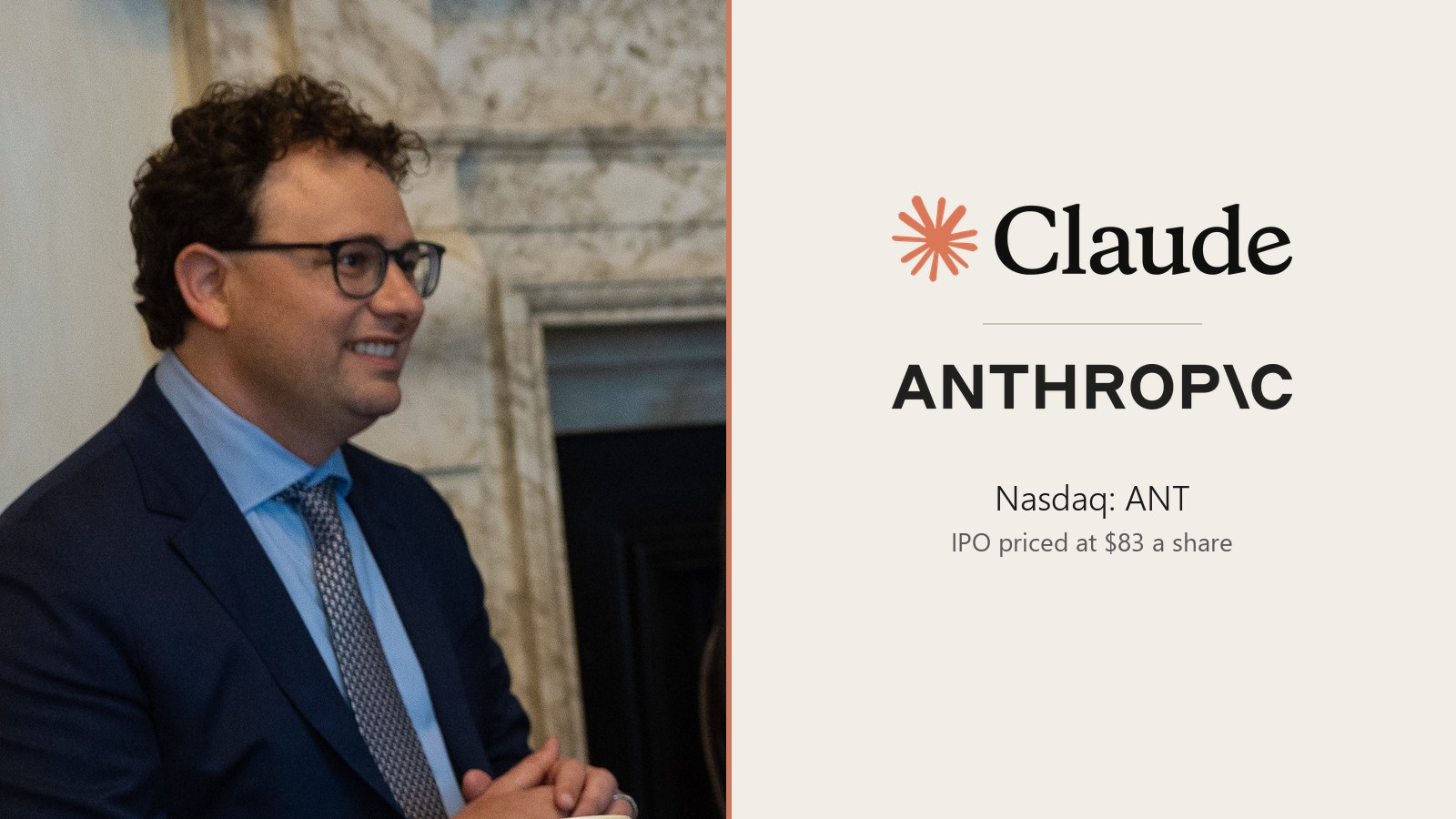
Anthropic, PBC, the maker of the Claude AI models, priced its initial public offering at $83.00 a share on 18 Nov 2026, $5 above the top of its $70 to $78 marketing range, and its Class A shares began trading on the Nasdaq Global Select Market under the ticker ANT on 19 Nov. The company sold 980 million Class A shares for gross proceeds of $81.34 billion, according to its final prospectus filed with the US SEC, and is raising a further $26.0 billion from seven technology companies in a concurrent private placement at the same price.
At $83, Anthropic is valued at about $1.5 trillion on a fully diluted basis, counting options, unvested stock units and convertible notes, the figure reported by CNBC and TechCrunch. On the 13.22 billion shares outstanding after the offering alone, the value is about $1.10 trillion. Six months earlier, Anthropic's Series H round valued it at $965 billion.
Key highlights
- Offer price: $83.00 a share, above the $70 to $78 range
- Size: 980 million Class A shares, upsized from 825 million; $81.34 billion gross
- Private placement: $26.0 billion of non-voting shares to Google, NVIDIA, AMD, Broadcom, Micron, Microsoft and TSMC Partners
- Valuation at $83: about $1.5 trillion fully diluted; about $1.10 trillion on shares outstanding
- Amazon and Google: 14.6% and 13.4% of the company, with no votes
- Control: one founder share carries 50.1% of the vote; a trust elects a majority of the board
- Revenue: $33.24 billion in the nine months to 30 Sep 2026, against $2.55 billion a year earlier
- Run-rate revenue: about $81 billion as of 31 Oct 2026, company-defined
IPO terms
| Parameter | Details |
|---|---|
| Issuer | Anthropic, PBC (Delaware public benefit corporation) |
| Exchange and ticker | Nasdaq Global Select Market, ANT |
| Price range | $70.00 to $78.00 (not revised before pricing) |
| Offer price | $83.00 |
| Shares offered | 980,000,000 Class A: 956,351,354 new shares and 23,648,646 sold by the founders |
| Gross proceeds | $81.34 billion |
| Underwriting discount | $550 million, about 0.68% of gross proceeds |
| Option for underwriters | 147,000,000 more shares from the company, about $12.2 billion at $83 |
| Concurrent private placement | 313,253,007 non-voting Class N shares, $26.0 billion |
| Lead underwriters | Goldman Sachs, Morgan Stanley, J.P. Morgan, Citigroup (22 banks in all) |
| Pricing / first trade / closing | 18 Nov / 19 Nov / on or about 20 Nov 2026 |
Source: Anthropic final prospectus (Form 424B4), 18 Nov 2026. Percentages computed by Blacklitt.
The offering was upsized late. The amended filings of 10 and 17 Nov offered 825 million shares at the $70 to $78 range; the final prospectus added 155 million new shares and raised the price to $83. The number of shares sold by existing holders did not change. After underwriting discounts, the company receives $78.84 billion from the IPO and about $104.8 billion including the private placement, or about $117 billion if the underwriters buy all their extra shares.
The shares sold to the public are a small slice of the company. The 980 million Class A shares are about 7.4% of the 13.22 billion shares outstanding after the offering.
Valuation depends on the share count
Two valuation figures are in circulation, and both use the $83 price. The headline figure, about $1.5 trillion, reported by CNBC and TechCrunch, is the fully diluted value. The lower one, about $1.10 trillion, multiplies the price only by the 13,219,642,276 shares that will be outstanding after the offering (7.58 billion Class A and 5.64 billion Class N). The fully diluted figure also counts shares that can still be created: 1.77 billion options with a weighted-average exercise price of $2.91, more than 1 billion unvested restricted stock units, Class N shares from Amazon convertible notes that a 12% ownership cap has held back, and a share-matching pledge for employee donations.
Earlier figures of $1.33 trillion to $1.4 trillion that appeared before pricing correspond to the fully diluted count at the middle and top of the marketing range.
Valuation path from $61.5 billion
| Round | Announced | Amount | Post-money valuation | Led by |
|---|---|---|---|---|
| Series E | Mar 2025 | $3.5 billion | $61.5 billion | Lightspeed Venture Partners |
| Series F | Sep 2025 | $13 billion | $183 billion | ICONIQ; co-led by Fidelity and Lightspeed |
| Series G | Feb 2026 | $30 billion | $380 billion | GIC and Coatue |
| Series H | May 2026 | $65 billion | $965 billion | Altimeter, Dragoneer, Greenoaks and Sequoia |
| IPO | Nov 2026 | $81.34 billion, plus $26.0 billion placement | About $1.5 trillion (fully diluted); about $1.10 trillion (outstanding) | Goldman Sachs, Morgan Stanley, J.P. Morgan, Citigroup |
Round sizes and valuations as announced by the company or reported by CNBC and TechCrunch; Series H includes $15 billion committed earlier. IPO figures from the 424B4.
The private valuation rose about 16 times in 14 months, from $61.5 billion in March 2025 to $965 billion in May 2026. Series G co-leads included D. E. Shaw Ventures, Dragoneer, Founders Fund, ICONIQ and MGX, according to the company's February announcement. The prospectus shows Google put $10.0 billion and Amazon $5.0 billion into Series H.
Strategic investors and their money
Much of Anthropic's capital has come from the companies that sell it cloud capacity and chips. The prospectus records Amazon funding about $13 billion: $8 billion through convertible notes issued from 2023 to 2025 and $5 billion in Series H. A 2026 note agreement of up to $20 billion leaves $15 billion still available. The Amazon notes, $6.2 billion as of 30 Sep 2026, are the company's only debt.
Google's 2026 note agreement allows up to $30 billion through 2030. It used $10 billion for Series H, and its $10 billion share of the IPO placement is funded from the same facility. Microsoft and NVIDIA committed up to $5 billion and $10 billion in November 2025, according to CNBC.
| Buyer | Class N shares | Amount |
|---|---|---|
| 120,481,927 | $10.0 billion | |
| NVIDIA | 120,481,927 | $10.0 billion |
| AMD | 30,120,481 | $2.5 billion |
| Broadcom | 12,048,192 | $1.0 billion |
| Micron | 12,048,192 | $1.0 billion |
| Microsoft | 12,048,192 | $1.0 billion |
| TSMC Partners | 6,024,096 | $0.5 billion |
| Total | 313,253,007 | $26.0 billion |
Source: 424B4. The placement closes immediately after the IPO; it carries no underwriting fee and the shares are not subject to lock-up.
Amazon and Google own 28% but cannot vote
Anthropic has five share classes, and economic ownership and voting control sit with different holders. After the offering, Amazon holds 1,936,452,353 Class N shares and Google holds 1,774,959,745, or 14.6% and 13.4% of all outstanding capital stock. Class N shares carry no votes, so neither company appears among holders of 5% of the vote. Class N shares become voting Class A shares only when sold to an unaffiliated buyer.
Both stakes are capped. Amazon's notes cannot convert into more than 12% of the fully diluted company; converted in full without the cap, Amazon would hold 3.48 billion Class N shares, or 23.6% of capital stock. Google's 2026 agreement stops any issue that would take it above 14.99% on a post-money, as-converted basis.
| Class | Shares | Economic rights | Voting |
|---|---|---|---|
| Class A (listed) | 7,583,103,996 | Yes | One vote a share; at most 49.9% of the total vote as a class |
| Class N | 5,636,538,278 | Yes | None |
| Class F | 1 (Founder LLC) | No | Fixed 50.1% of the vote on general matters, including electing directors other than Class T directors |
| Class T | 1 (Long-Term Benefit Trust) | No | Elects and removes the Class T directors, a majority of the board |
| Class E | 0 | No | Limited matters only; reserved for employees |
Source: 424B4, description of capital stock.
Founders hold the deciding vote through one share
The seven co-founders, Dario Amodei, Daniela Amodei, Tom Brown, Jack Clark, Jared Kaplan, Sam McCandlish and Chris Olah, are the members of the Founder LLC, which holds the single Class F share. That share carries 50.1% of the vote on matters put to stockholders generally, whatever the number of Class A shares, which makes Anthropic a "controlled company" under Nasdaq rules and exempts it from some board-independence requirements.
Each co-founder sold 3,378,378 shares in the IPO, about $280 million each before discounts and $1.96 billion for the seven together. Each still beneficially owns between 237 million and 241 million Class A shares, about 3.1% to 3.2% of the class. At $83, each holding is worth roughly $20 billion.
Board control runs through a second channel. The Long-Term Benefit Trust, meant to operate with five financially disinterested trustees, owns the single Class T share and elects a majority of the directors. As a public benefit corporation, Anthropic's stated purpose is "the responsible development and maintenance of advanced AI for the long-term benefit of humanity", and its directors must balance that purpose against stockholders' financial interests. A wholly owned subsidiary, Anthropic Public Benefit Fund LLC, received 846.8 million Class N shares, equal to 5% of fully diluted shares at 30 Jun 2026.
Revenue grew about 13 times in nine months
| Particulars | FY2024 | FY2025 | 9M 2025 | 9M 2026 |
|---|---|---|---|---|
| Revenue | 386 | 4,585 | 2,545 | 33,242 |
| Operating loss | (2,980) | (8,060) | (5,224) | (1,260) |
| Net loss | (8,309) | (41,965) | (25,107) | (104,039) |
| Operating cash flow | (5,692) | (2,637) | (2,024) | 6,569 |
Figures in $ million. 9M = nine months to 30 Sep. Source: 424B4.
Revenue for the nine months to 30 Sep 2026 was $33.24 billion, about 13 times the $2.55 billion of the same period in 2025, and more than seven times all of 2025. The operating loss narrowed to $1.26 billion from $5.22 billion, and operating cash flow turned positive at $6.57 billion. On the company's adjusted measure, operating income was $4.08 billion, a 12% margin.
The $104.04 billion net loss for the nine months is mostly an accounting charge. It includes a non-cash fair-value charge of $94.3 billion on convertible notes and related derivatives, which grew in value as the company's valuation rose. The prospectus does not report a gross margin; its main cost line, compute and infrastructure, was $18.81 billion for the nine months.
The company's own Run-Rate Revenue measure, 28 days of usage multiplied by 13 plus monthly subscriptions multiplied by 12, was about $81 billion on 31 Oct 2026, up $10 billion in one month. Customers paying $100,000 or more over 12 months rose from more than 950 to more than 11,900 between 30 Sep 2025 and 30 Sep 2026, and they produced 74% of trailing 12-month revenue. Cash, cash equivalents and short-term investments were $131.8 billion on 30 Sep 2026, or $232.4 billion after the offering on the prospectus's pro forma basis.
$900 billion of compute commitments
The largest number in the prospectus is a spending commitment. Anthropic has signed contracts with an aggregate committed spend of about $900.9 billion, substantially all for compute and infrastructure, of which about $451.6 billion falls due before the end of 2030 and the rest from 2031 to 2045. Against these largely fixed payments, most revenue is consumption-based and not under long-term contract, a mismatch the company lists among its main risks.
The proceeds are for general corporate purposes, including compute, infrastructure and hiring, and possible acquisitions, none of which are agreed. The founders' share sales bring the company no money.
Risks the prospectus flags
- Model behaviour: models have behaved, and may behave, in misaligned or harmful ways, and safety tests may not catch it; the company notes models can act differently when they detect they are being evaluated
- Fixed costs: about $900.9 billion of long-term compute commitments against mostly usage-based revenue
- Financing ties: $6.2 billion of Amazon notes, credit agreement obligations and chip-supplier terms linked to financings
- Limited say for public holders: the Class F vote and the trust-elected board limit Class A holders' influence and deter takeovers
- Unaudited metrics: run-rate revenue, net revenue retention and customer counts rest on assumptions, and the company expects growth rates to fall
Lock-up and next dates
About 15.5 billion share equivalents are locked up. The standard period is 180 days; the co-founders and holders of more than 0.5% of fully diluted shares are locked up for up to 365 days. Some holdings can be released early, including up to 10% of locked-up shares held by employees, officers and non-founder directors from the first trading day. The private placement shares are not locked up. The offering is expected to close on or about 20 Nov 2026.
Inference
At $83, the public is buying into a company valued at about 18.5 times its stated run-rate revenue on the fully diluted figure, or about 13.5 times on shares outstanding. The structure means Class A buyers take economic exposure without control: the founders' 50.1% vote and the trust-elected board decide the company's direction, and the two largest economic owners, Amazon and Google, have no vote either. The money raised, about $105 billion with the placement, compares with $70.7 billion of commitments due within 12 months, so how fast revenue keeps growing against fixed compute bills is the number to follow in the first quarterly reports.
Indian residents can hold US-listed shares such as ANT through the Reserve Bank of India's Liberalised Remittance Scheme, which allows remittances of up to $250,000 a person per financial year. This article is for information only and is not a recommendation to buy or sell any security.
Written from news reports and company statements, as of . Reference: Original filing
Disclaimer:
The information available on this article is provided for education and informational purposes only. It does not constitute or provide financial, investment or trading advice and should not be construed as an endorsement of any specific stock or financial strategy in any form or manner. We do not make any representations or warranties regarding the quality, reliability, or accuracy of the information provided. This website may contain links to third-party content. We are not responsible for the content or accuracy of these external sources and do not endorse or verify the information provided by third parties. We are not liable for any decisions made or actions taken based on the information provided on this website.
Figures are from the company's filings with the US Securities and Exchange Commission and are in US dollars. Investing in US stocks from India is subject to the Liberalised Remittance Scheme, currency risk and taxes in both countries.