ELSS New Tax Regime: Is It Still Worth It?
- Tax
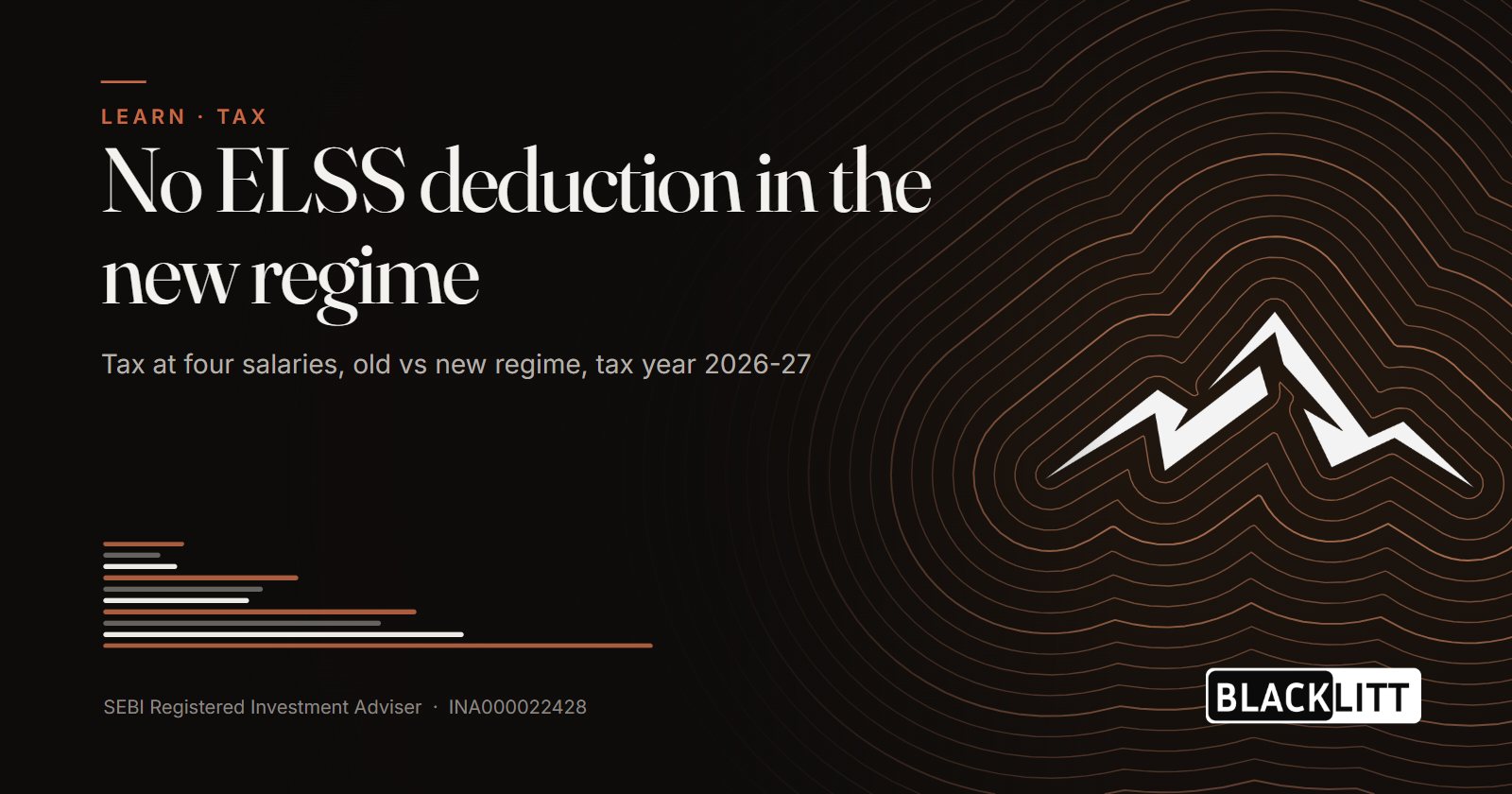
The ELSS new tax regime question comes down to one point: ELSS gives no tax deduction there, because deductions under section 123 (formerly 80C) are not available. Whether ELSS is worth it therefore depends on whether your old-regime deductions are large enough to make the old regime cheaper.
ELSS is an equity fund with a 3-year lock-in, and its gains are taxed as equity. Its ₹1.5 lakh deduction limit continues in the old regime. This article covers what changes in the new regime, the tax at four salary levels, and how to compare ELSS with an ordinary flexi cap fund.
New regime offers no ELSS deduction
The new regime is the default unless you opt out. In it, section 123 (formerly 80C) deductions are not available, so an ELSS investment does not lower your taxable income. The old regime keeps the ₹1.5 lakh limit.
The new regime has a rebate that makes tax nil up to ₹12 lakh of income. That is about ₹12.75 lakh of salary after the ₹75,000 standard deduction. The rebate does not apply to special-rate income, so it does not cover equity capital gains.
Equity gains tax in both regimes
Equity gains are taxed under equity rules whichever regime you choose. Gains on units held over 12 months are taxed at 12.5% above ₹1.25 lakh in a financial year. These rates apply to units sold on or after 23 July 2024, before surcharge and cess.
ELSS units carry a 3-year lock-in, so every ELSS gain is long-term. Because the rebate does not cover these gains, they can be taxed even when your slab tax is nil. For the wider rules, read how mutual funds are taxed in India, and for the basics of how funds pool money, read what a mutual fund is.
Tax at four salary levels
Table 1 shows tax under three cases at four salaries. The new regime figure is the same whether or not you invest in ELSS, because ELSS is not deductible there.
| Salary | New regime tax | Old regime tax, no ELSS | Old regime tax with ₹1.5 lakh ELSS |
|---|---|---|---|
| ₹10,00,000 | ₹0 | ₹1,06,600 | ₹75,400 |
| ₹15,00,000 | ₹97,500 | ₹2,57,400 | ₹2,10,600 |
| ₹20,00,000 | ₹1,92,400 | ₹4,13,400 | ₹3,66,600 |
| ₹30,00,000 | ₹4,75,800 | ₹7,25,400 | ₹6,78,600 |
Data note: Tax year 2026-27 rules, as of October 2026. Illustrative figures.
The assumptions are these. The figures apply to a salaried resident under 60. The only deductions are the standard deduction, which is ₹75,000 in the new regime and ₹50,000 in the old, and, in the old regime, ₹1.5 lakh under section 123 (formerly 80C) for ELSS. There is no HRA, home loan interest, NPS or other deduction. Tax includes 4% cess. Surcharge and marginal relief are ignored, so higher incomes may see different totals.
- New regime
- Old, no ELSS
- Old + ELSS
Illustrative. Tax year 2026-27, including 4% cess. Same assumptions as the table above.
At all four salaries, the new regime tax is lower than the old regime tax even after ₹1.5 lakh goes into ELSS. The old regime needs much larger deductions to catch up.
Break-even deductions for the old regime
Table 2 shows the total old-regime deductions at which old regime tax falls to the new regime level. The total includes ELSS, HRA, home loan interest and other deductions, all counted beyond the ₹50,000 standard deduction.
| Salary | Total deductions needed beyond ₹50,000 |
|---|---|
| ₹15,00,000 | ₹5,44,000 |
| ₹20,00,000 | ₹7,09,000 |
| ₹30,00,000 | ₹8,00,000 |
Data note: Rounded up to the nearest ₹1,000. Same assumptions as Table 1. No row is shown for ₹10 lakh.
The ₹1.5 lakh ELSS limit is one item in that total. At ₹20 lakh, the total needed is ₹7,09,000, so ELSS alone covers only part of it.
Steps to compare the two regimes
Table 3 sets out how to work out the comparison for your own salary.
| Step | What to do | Example |
|---|---|---|
| 1. Note your salary | Write down your gross salary | Table 1 and Table 2 use ₹10, ₹15, ₹20 and ₹30 lakh |
| 2. Find your new regime tax | Use the nearest row only if your salary matches, or use an income tax calculator | ₹20 lakh salary: ₹1,92,400 |
| 3. Total your old regime deductions beyond ₹50,000 | Add ELSS (up to ₹1.5 lakh), HRA, home loan interest and others | ELSS alone: ₹1,50,000 |
| 4. Compare with the break-even figure | Check your total against the figure for your salary | ₹20 lakh salary: ₹7,09,000 |
| 5. Check the non-tax side of ELSS | Weigh the 3-year lock-in and equity market risk | Applies in either regime |
If your deductions total less than the break-even figure, the old regime costs more than the new regime under these assumptions. If they total more, the old regime costs less. The lock-in and market risk of ELSS apply either way.
ELSS compared with a flexi cap fund
Both are equity funds, so both carry market risk. Table 4 sets out the main differences.
| Feature | ELSS | Flexi cap fund |
|---|---|---|
| Minimum in equity | 80% | 65% |
| Lock-in | 3 years | None |
| Section 123 (formerly 80C) deduction | Old regime only, up to ₹1.5 lakh a tax year | Not applicable |
| Tax on gains held over 12 months | 12.5% above ₹1.25 lakh a financial year | 12.5% above ₹1.25 lakh a financial year |
| Tax on gains held 12 months or less | Not applicable, because of the lock-in | 20% |
| Selling before the end of 3 years | Not allowed | Allowed, subject to any exit load |
Data note: Rules as of October 2026. Tax rates apply to units sold on or after 23 July 2024, before surcharge and cess.
ELSS can make sense for an old-regime taxpayer who already plans to invest in equity and can leave the money locked for 3 years. Its deduction matters only in the old regime. Without that deduction, ELSS is an equity fund with a lock-in, and the lock-in is the main difference from a flexi cap fund. Neither is better in every case. The lock-in can help some investors stay invested, and it can be a constraint for others who may need the money.
Frequently asked questions
Can I claim ELSS under the new tax regime?
No. In the new tax regime, deductions under section 123 (formerly 80C) are not available, so an ELSS investment does not reduce your taxable income. The new regime is the default unless you opt out, and the old regime still allows up to ₹1.5 lakh a tax year.
Does the ₹12 lakh rebate cover ELSS gains?
No. The rebate is not available against special-rate income such as equity capital gains. Gains above ₹1.25 lakh in a financial year are taxed at 12.5% for units sold on or after 23 July 2024, even when your slab tax is nil.
Is ELSS better than a flexi cap fund?
Neither is better in every case. ELSS offers a deduction in the old regime but locks your money for 3 years, while a flexi cap fund has no lock-in and no deduction. Compare the two on the lock-in, the equity minimum and how soon you may need the money.
How much deduction does the old regime need to match the new one?
It depends on your salary. The break-even figure is the total old-regime deduction beyond the ₹50,000 standard deduction at which the tax matches the new regime. Under the assumptions in this article, the figure is ₹7,09,000 at a ₹20 lakh salary and ₹8,00,000 at ₹30 lakh. ELSS is one item in that total.
Disclaimer
This article reflects the author's views as of 24 October 2026. Past performance does not indicate future returns. Examples that use assumed returns are for illustration only and are not projections. Consider your own goals and risk profile before investing.
Investment in securities market are subject to market risks. Read all the related documents carefully before investing.
The securities quoted are for illustration only and are not recommendatory.
Registration granted by SEBI, membership of BASL and certification from NISM in no way guarantee performance of the intermediary or provide any assurance of returns to investors.
Blacklitt Technologies Private Limited · SEBI RIA INA000022428 · BSE enlistment 2491