ETF vs Mutual Fund: How They Differ and Which Suits You
The main ETF vs mutual fund difference is how you buy and sell. An ETF trades on a stock exchange at a market price, so you need a demat and trading account. A mutual fund is bought from the fund house at its NAV, with no demat account needed.
An index ETF and an index fund can track the same index, so the choice comes down to cost, convenience and how often you trade.
ETF trading on the stock exchange
An exchange traded fund, or ETF, is a fund whose units are listed on a stock exchange. You place an order through a broker and the price moves through the trading day. Most ETFs track an index, so the portfolio is a basket of the companies in that index.
The market price can differ slightly from the fund's NAV. Market makers help keep the two close, and an indicative NAV (iNAV) is published through the day as a reference. Liquidity depends on trading on the exchange, and a thinly traded ETF can show a wider gap between buy and sell prices.
A mutual fund is priced once a day. You buy from the fund house, or through an app or platform, at that day's net asset value, or NAV, and redeem with the AMC at NAV, so the price does not depend on other investors. An index fund is a mutual fund that tracks an index in this way.
ETFs, index funds and active funds side by side
| Feature | ETF | Index fund | Active fund |
|---|---|---|---|
| Where you buy | Stock exchange, through a demat and trading account | From the AMC or an app or platform, at NAV | From the AMC or an app or platform, at NAV |
| Price | Market price, which can differ slightly from NAV | NAV | NAV |
| Demat account needed | Yes | No | No |
| Liquidity | Depends on trading volume on the exchange | Redeem with the AMC at NAV | Redeem with the AMC at NAV |
| Brokerage | Broker charges on each buy and sell, which vary by broker | None for the investor on purchase | None for the investor on purchase |
| Expense ratio cap | 0.90% base expense ratio (index funds and ETFs) | 0.90% base expense ratio (index funds and ETFs) | Slab-based; 2.10% on the first ₹500 crore for equity-oriented funds |
Caps as of October 2026, under the SEBI (Mutual Funds) Regulations, 2026.
Brokerage and expense ratio limits
Each ETF purchase and sale goes through a broker, whose charges vary by platform and repeat with every trade. Index funds and active funds bought from the AMC carry no brokerage for the investor on purchase.
From 1 April 2026, the base expense ratio for index funds and ETFs is capped at 0.90% a year. For equity-oriented active funds, the cap is set in slabs by daily net assets, starting at 2.10% on the first ₹500 crore and falling as the fund grows. A cap is a ceiling, so a fund can charge less. On ₹10 lakh, a 0.90% charge costs ₹9,000 a year, while a hypothetical 0.20% costs ₹2,000. Read how expense ratios work for what the charge covers.
Cost gap on ₹10 lakh over 20 years
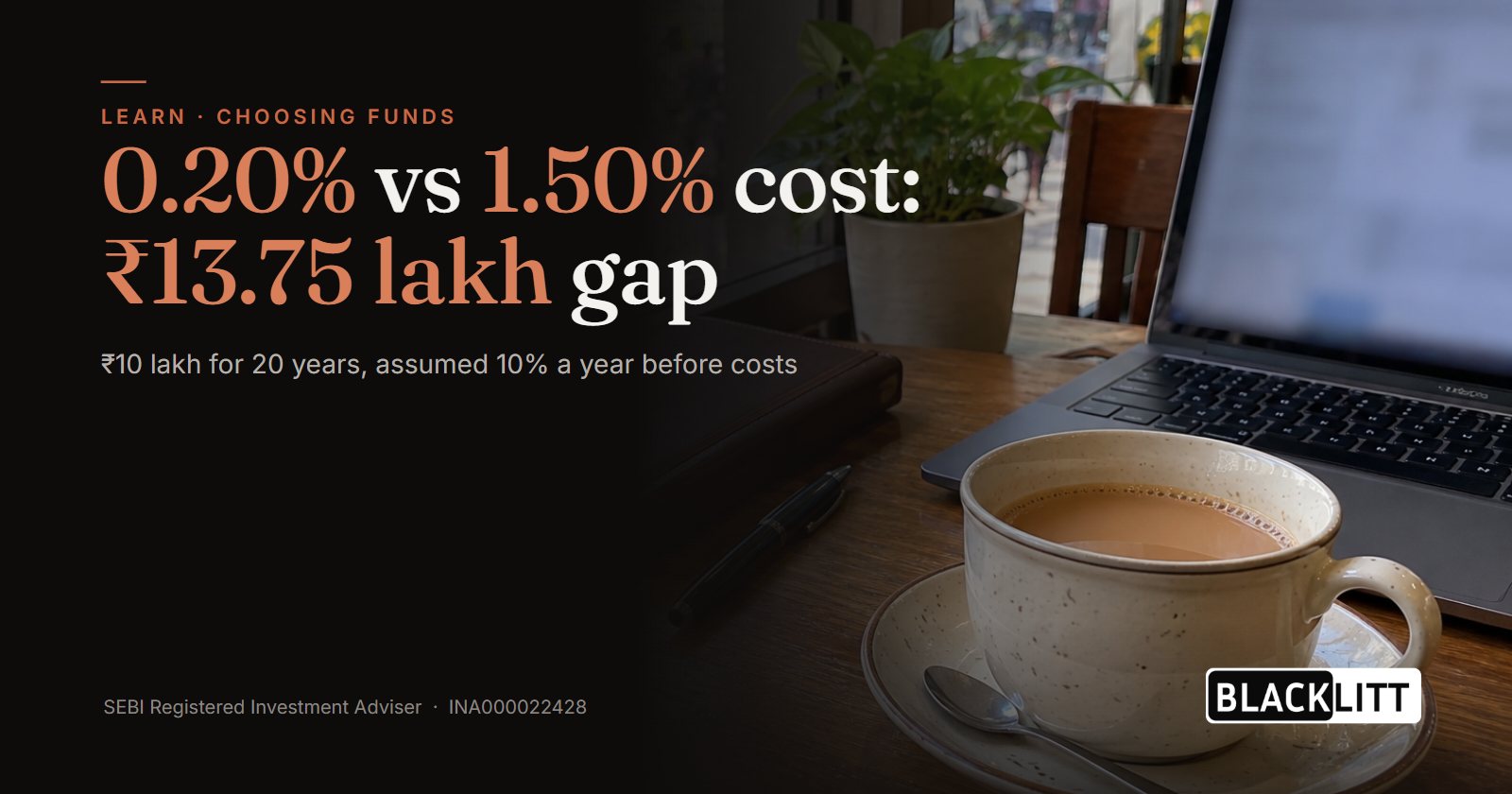
Suppose ₹10 lakh is invested once at an assumed 10% a year before costs, in a hypothetical index fund or ETF charging 0.20% and a hypothetical active fund charging 1.50%.
| Period | Before any costs (₹ lakh) | Index fund or ETF at 0.20% (₹ lakh) | Active fund at 1.50% (₹ lakh) | Gap, index vs active (₹ lakh) |
|---|---|---|---|---|
| After 10 years | 25.94 | 25.47 | 22.61 | 2.86 |
| After 20 years | 67.27 | 64.87 | 51.12 | 13.75 |
The example leaves out brokerage, tax and tracking difference. An active fund may return more or less than its index, so this shows only the effect of cost.
- Index fund or ETF at 0.20%
- Active fund at 1.50%
Illustrative figures at an assumed 10% a year before costs.
Tax treatment of equity ETFs and index funds
ETFs and index funds that track Indian share indices are equity-oriented, so they follow the same capital gains rules as other equity funds. For units transferred on or after 23 July 2024, short-term gains (units held 12 months or less) are taxed at 20%. Long-term gains are taxed at 12.5% above ₹1.25 lakh a financial year, for units on which securities transaction tax (STT) was paid. Surcharge and 4% cess apply in addition. For other categories, see how mutual funds are taxed in India.
Choosing an ETF vs mutual fund for your needs
Situations that favour an ETF
- You already have a demat and trading account and are comfortable placing orders.
- You want to buy or sell during market hours at a price you can see.
- You hold shares in a demat account and want everything in one place.
Situations that favour an index fund or active fund
- You invest through a monthly SIP and want to avoid a separate trade for each instalment.
- You do not want to open or maintain a demat account.
- You want a fund manager to pick stocks. An active fund carries a higher expense ratio and may return more or less than the index, so it has to earn back its cost through performance.
Frequently asked questions
Can I buy an ETF without a demat account?
No. An ETF is bought and sold on a stock exchange, so you need a demat account to hold the units and a trading account to place orders. A mutual fund, including an index fund, can be bought from the fund house or an app without a demat account.
Is an index fund cheaper than an ETF?
Both are capped at a 0.90% base expense ratio under the 2026 rules, but the actual charge of each scheme can be lower. An ETF also charges brokerage on every trade, so for regular monthly investing an index fund bought from the AMC is often simpler and can cost less.
Do ETFs and index funds have the same tax?
For schemes that track Indian share indices, yes. As of October 2026, short-term gains on units transferred on or after 23 July 2024 are taxed at 20%, and long-term gains are taxed at 12.5% above ₹1.25 lakh a financial year, for units that paid securities transaction tax (STT).
Which suits a beginner better, an ETF or a mutual fund?
For most beginners, a mutual fund, often an index fund bought from the AMC or an app, is the simpler start. It needs no demat account and buys at NAV, so there is no market price to time. An ETF suits someone already comfortable with a trading account who wants to trade on the exchange.
Disclaimer
This article reflects the author's views as of 8 November 2026. Past performance does not indicate future returns. Examples that use assumed returns are for illustration only and are not projections. Consider your own goals and risk profile before investing.
Investment in securities market are subject to market risks. Read all the related documents carefully before investing.
The securities quoted are for illustration only and are not recommendatory.
Registration granted by SEBI, membership of BASL and certification from NISM in no way guarantee performance of the intermediary or provide any assurance of returns to investors.
Blacklitt Technologies Private Limited · SEBI RIA INA000022428 · BSE enlistment 2491