Retirement Planning With Mutual Funds: A Step-by-Step Guide
Retirement planning with mutual funds means building a corpus large enough to cover your expenses after you stop working, through SIPs during your earning years and an SWP once you retire. The key number is the corpus you need on the day you retire, and inflation makes it far larger than today's expenses suggest.
Most people plan in today's rupees, which is where the gap starts. The steps below turn that gap into a monthly SIP. The broader approach is covered in goal-based investing.
Two phases of retirement planning with mutual funds
Retirement planning has two phases. In the accumulation phase, you invest regularly and let the money grow. In the withdrawal phase, the corpus pays your expenses and the aim shifts to making it last.
| Measure | Accumulation phase | Withdrawal phase |
|---|---|---|
| Typical timing | From the first SIP until retirement | From retirement onwards |
| What the money does | Monthly SIPs build the corpus | An SWP pays a set amount from the corpus |
| Usual fund mix | Mostly equity early on, shifting over time | A mix of equity and debt, set by your needs |
A general pattern. Timing depends on your own plan.
Working out the corpus you need
The corpus is the lump sum you need on the day you retire, so that withdrawals can cover your expenses for the rest of the plan. Expenses keep rising after retirement, so the target is a monthly figure at age 60, not today's expense. The full method is in how to calculate a retirement corpus.
A worked example from age 30
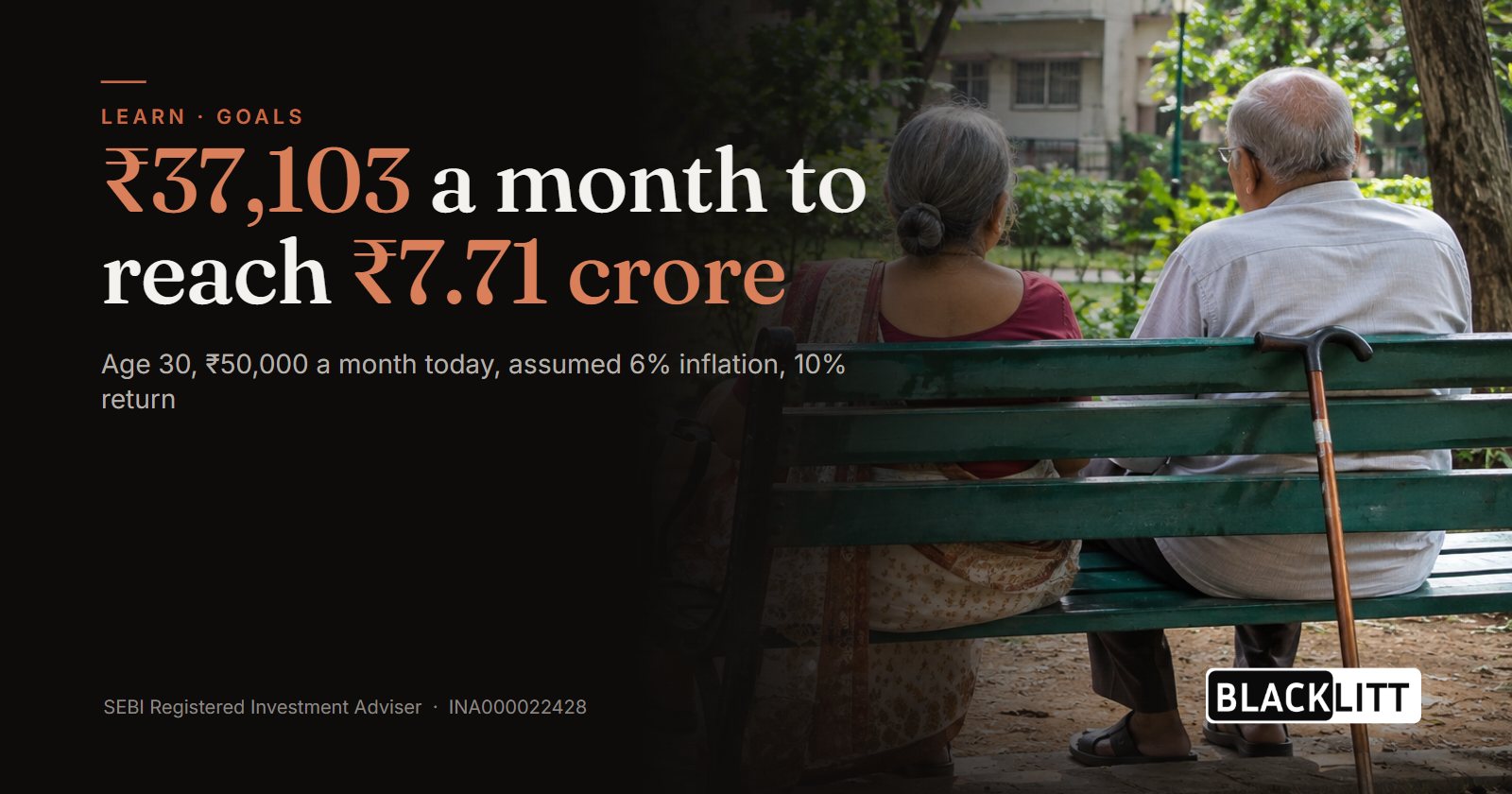
Suppose you are 30, spend ₹50,000 a month today, and plan to retire at 60 and live to 85. The figures below assume 6% inflation and a 7% return after retirement.
| Item | Illustrative figure |
|---|---|
| Monthly expense today | ₹50,000 |
| Monthly expense at 60 (assumed 6% inflation) | ₹2,87,175 |
| Annual expense at 60 | ₹34.46 lakh |
| Years of retirement planned | 25 |
| Corpus needed at 60 (assumed 7% return after retirement) | ₹771.48 lakh (about ₹7.71 crore) |
| Corpus as a multiple of first-year expense | 22.4 times |
Illustrative figures.
At 6% inflation, ₹50,000 today becomes ₹2,87,175 a month at 60. The corpus needed is 22.4 times the first-year expense, which is why retirement goals can feel much larger than the monthly figure suggests.
Monthly SIP needed to reach the corpus
Building ₹7.71 crore over 30 years takes a monthly SIP, and the amount depends on the return you assume. The table shows two assumed returns.
| Assumed annual return before retirement | Monthly SIP needed (₹) |
|---|---|
| 10% | 37,103 |
| 12% | 25,040 |
SIPs paid at the start of each month for 30 years at a constant return.
Two percentage points of return move the monthly SIP from ₹37,103 to ₹25,040, so test more than one return before you settle on a number.
Inflation changes the target
Inflation is one of the largest drivers of the target. The table shows the effect at 5%, 6% and 7%.
| Assumed inflation | Monthly expense at 60 (₹) | Corpus needed at 60 (₹ lakh) |
|---|---|---|
| 5% | 2,16,097 | 521.73 |
| 6% | 2,87,175 | 771.48 |
| 7% | 3,80,613 | 1,141.84 |
Assumes a 7% return after retirement and 25 years of withdrawals.
Illustrative figures. Assumes a 7% return after retirement.
Shifting from equity to debt near retirement
Equity funds can grow the corpus, but their value can fall sharply in a bad year, and a fall close to retirement leaves less time to recover. Many investors therefore move gradually from equity to debt as retirement nears, usually over several years.
Life Cycle Funds follow this pattern. As of October 2026, SEBI's categorisation circular of 26 February 2026 created the Life Cycle Fund category: open-ended funds with a target maturity year, whose mix moves from equity toward debt. The same circular discontinued solution-oriented schemes, including retirement funds, from that date. Existing ones stopped taking fresh subscriptions and are to be merged into similar schemes with SEBI approval.
Each move from an equity fund to a debt fund is a redemption and a fresh purchase, so it can trigger capital gains tax and any exit load. Gains on debt-oriented fund units bought on or after 1 April 2023 are taxed at your slab rate, as of October 2026.
Withdrawals after retirement with an SWP
Once you retire, a systematic withdrawal plan (SWP) pays a set amount each month from the corpus. Only the gain part of each redemption is taxed. As of October 2026, equity fund short-term gains are taxed at 20%, and long-term gains above ₹1.25 lakh in a financial year at 12.5%, for units sold on or after 23 July 2024. See mutual fund taxation in India and what an SWP is.
The drawdown example withdraws ₹2,87,175 a month in the first year, rising 6% a year with inflation, while the rest of the corpus earns an assumed 7%.
| Years into retirement | Corpus left (₹ lakh) |
|---|---|
| 10 years | 867.54 |
| 20 years | 542.37 |
Withdrawals taken at the start of each year.
The corpus first grows, because early returns exceed early withdrawals. Rising withdrawals then pull it down, and the plan is sized so that it runs out at 85.
Six steps from today to retirement
| Step | What to do | Example (illustrative) |
|---|---|---|
| 1 | Estimate your monthly expense today | ₹50,000 a month |
| 2 | Set an inflation assumption | 6% a year |
| 3 | Work out the corpus needed at 60 | ₹771.48 lakh |
| 4 | Choose a monthly SIP that builds the corpus | ₹37,103 a month at an assumed 10% return |
| 5 | Shift gradually toward debt as the date nears | Start the move in the final years before retirement |
| 6 | Plan the SWP and review it each year | Withdrawals sized so the corpus lasts to age 85 |
Common mistakes in retirement planning
- Planning with today's expenses and leaving inflation out of the target.
- Relying on one return assumption instead of testing a range.
- Stopping SIPs during a market fall, which cuts the number of instalments that build the corpus.
Frequently asked questions
How much should I save for retirement with mutual funds?
The amount depends on the monthly expense you expect at 60, the inflation rate and the return you assume. In the example above, a monthly expense of ₹50,000 today at age 30 leads to a corpus of ₹771.48 lakh at 60, which needs a monthly SIP of ₹37,103 at an assumed 10% return. Your own figures will differ, so rerun the numbers with your expenses.
Should I move to debt funds before retiring?
Many investors shift gradually toward debt as retirement approaches, since a sharp fall in equities close to retirement leaves less time to recover. The shift is a judgement about your timeline and risk comfort. Each switch is a redemption that can trigger capital gains tax and any exit load, so spreading it over several years helps.
How does an SWP work in retirement?
An SWP redeems units each month to pay a fixed amount to your bank account. Only the gain part of each sale is taxed. Withdrawals that rise with inflation draw the corpus down faster, which is why the balance in the drawdown example falls between years 10 and 20.
What if inflation is higher than expected?
The corpus rises sharply with inflation. In the example, 7% inflation instead of 6% lifts the corpus needed at 60 to ₹1,141.84 lakh, against ₹771.48 lakh at 6%. Review the inflation assumption each year, and plan with a range rather than one number, since a higher inflation rate also raises the SIP you need.
Disclaimer
This article reflects the author's views as of 3 November 2026. Past performance does not indicate future returns. Examples that use assumed returns are for illustration only and are not projections. Consider your own goals and risk profile before investing.
Investment in securities market are subject to market risks. Read all the related documents carefully before investing.
The securities quoted are for illustration only and are not recommendatory.
Registration granted by SEBI, membership of BASL and certification from NISM in no way guarantee performance of the intermediary or provide any assurance of returns to investors.
Blacklitt Technologies Private Limited · SEBI RIA INA000022428 · BSE enlistment 2491