
What Is an Arbitrage Fund and How Does It Make Money
An arbitrage fund is a hybrid mutual fund that buys shares in the cash market and sells futures on the same stock at a higher price, locking in a small gap between the two. Because that gap is fixed when the trade is made, returns depend less on which way the market moves.
SEBI requires at least 65% of the fund to sit in equity and equity-related instruments, so the fund is taxed like an equity fund. Its return, though, behaves more like short-term debt than like a stock fund.
Locking in the price gap
Suppose a hypothetical stock trades at ₹1,000 in the cash market and ₹1,005 in the next-month futures market. The fund buys 100 shares for ₹1,00,000 and sells 100 futures at ₹1,005. The gap is ₹5 a share, or ₹500 in total, which is 0.5% of the money invested.
Futures prices converge to the cash price at expiry, so the gap is earned whichever way the stock moves.
| Price at expiry (₹) | Cash leg (₹) | Futures leg (₹) | Net gain (₹) |
|---|---|---|---|
| 1,050 | +5,000 | -4,500 | +500 |
| 950 | -5,000 | +5,500 | +500 |
Hypothetical stock. Brokerage, STT and other costs are ignored, so a real trade earns less than ₹500.
A return pattern closer to debt
The fund's return tracks the size of these gaps, not the level of share prices. The gap widens and narrows with market conditions. In calm markets the gap can shrink, and the fund's returns slow with it.
Arbitrage fund taxation compared with liquid funds
Tax can matter as much as the gross return. Equity-oriented funds, which include arbitrage funds, pay 20% short-term capital gains tax on gains from units sold within 12 months. Gains on units held longer than 12 months are taxed at 12.5% above ₹1.25 lakh a financial year, and both rates carry surcharge and 4% cess. These rates apply to transfers on or after 23 July 2024, as of October 2026. Units of a liquid fund bought on or after 1 April 2023 are taxed at the investor's slab rate, whatever the holding period. For more on equity rules, see equity mutual fund taxation.
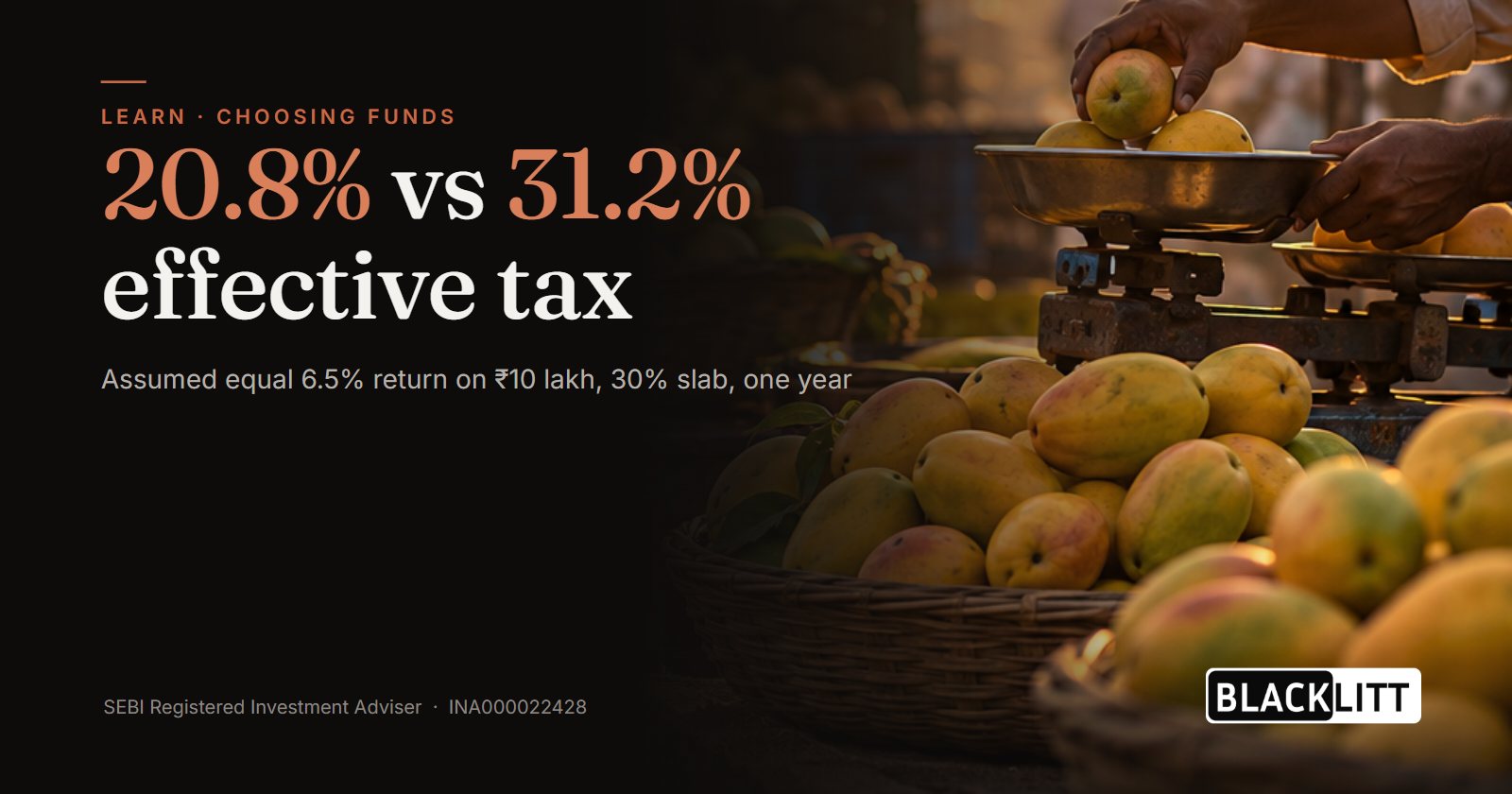
Suppose ₹10 lakh is invested for one year in each fund at an assumed 6.5% pre-tax return, so the gain is ₹65,000. The investor is in the 30% slab, with 4% cess and no surcharge.
| Measure | Liquid fund | Arbitrage fund, sold within 12 months | Arbitrage fund, sold after 12 months |
|---|---|---|---|
| Effective tax rate on gain (%) | 31.2 | 20.8 | 0 |
| Tax on ₹65,000 gain (₹) | 20,280 | 13,520 | 0 |
| Value after tax (₹) | 10,44,720 | 10,51,480 | 10,65,000 |
Illustrative figures at an assumed 6.5% return for each fund. The after-12-months case assumes the year's equity gains stay under the ₹1.25 lakh exemption.
Sold within 12 months, the arbitrage fund still pays less tax than the liquid fund here. Held past 12 months, it pays none, as long as the year's equity gains stay within the ₹1.25 lakh exemption.
Illustrative figures at an assumed 6.5% return, 30% slab, 4% cess.
Budget 2026 and the futures STT change
Budget 2026, presented on 1 February 2026, raised securities transaction tax (STT) on futures from 0.02% to 0.05%. It left the tax on mutual fund units unchanged. Arbitrage funds trade futures, so the higher charge can add to their costs.
On a hypothetical futures trade worth ₹1,00,500, STT is ₹20.10 at 0.02% and ₹50.25 at 0.05%. The extra ₹30.15 is 6.0% of the ₹500 gap in the example above, assuming STT is charged once on that trade. A fund that trades futures more often pays it more often, so the real effect depends on how much a particular fund trades.
Arbitrage and liquid funds side by side
| Feature | Arbitrage fund | Liquid fund |
|---|---|---|
| Source of return | Price gap between cash and futures | Interest on debt and money-market securities |
| Core holdings | At least 65% in equity and equity-related instruments | Debt and money-market securities maturing within 91 days |
| Tax treatment | Equity-oriented rates | Slab rate for units bought on or after 1 April 2023 |
| Exit load | Set by each scheme | Small graded load on exits in the first 7 days |
Exit loads vary by scheme. Tax rules as of October 2026. For a closer look at the debt side, read what a liquid fund is.
Investors arbitrage funds tend to suit
Arbitrage funds tend to suit investors who want a short-term place for money and prefer equity-oriented tax rates to slab-rate tax. They can fit money held for a few months to a year or two, such as a near-term goal or cash waiting to be invested in other equity funds. Investors who want a mix of equity and debt can also compare balanced advantage funds. Investors who need money within days may find a liquid fund a closer match.
Risks and trade-offs of arbitrage funds
The main trade-off is that the gap can shrink. If futures prices move closer to cash prices before the position closes, the locked return falls. Costs take a larger bite from a narrow gap, so brokerage, STT and the expense ratio matter more here than in a fund that earns from rising prices. Returns can also flatten in calm markets.
Public criteria for choosing an arbitrage fund
Compare funds on a few public measures. Start with the expense ratio, since costs come straight out of a narrow gap. Check how consistently the fund has returned across different periods rather than in one strong year. Look at the fund's size, its track record and the tenure of its fund manager. Finally, read the exit load and compare the fund's returns with a liquid fund over the same period, so you know what the equity tax treatment is buying you.
Frequently asked questions
Is an arbitrage fund the same as a liquid fund?
They are different. A liquid fund invests in debt and money-market securities maturing within 91 days, and its returns come from interest. An arbitrage fund holds at least 65% in equity and earns mainly from the price gap between the cash and futures markets. Their pre-tax returns can look similar in some periods, but their tax treatment and risks differ.
Are arbitrage funds taxed as equity funds?
Yes. Arbitrage funds are taxed as equity-oriented funds. Gains on units sold within 12 months are taxed at 20%, and gains above ₹1.25 lakh in a financial year on units held longer than 12 months are taxed at 12.5%. Surcharge and 4% cess are added to these rates. These rates apply to transfers on or after 23 July 2024, as of October 2026.
Do arbitrage funds carry market risk?
They are less exposed to the direction of the market, because the gap is set when the trade is made. They are not without risk, though. The gap can narrow, costs come out of a small margin, and returns can flatten in calm periods. Check the fund's recent return history before deciding how much of a portfolio to place in one.
Does Budget 2026 change arbitrage fund taxes?
Budget 2026 did not change the tax on mutual fund units. It did raise securities transaction tax on futures from 0.02% to 0.05%. Arbitrage funds trade futures, so the higher charge can add to their costs, and the effect depends on how much a particular fund trades.
Disclaimer
This article reflects the author's views as of 10 November 2026. Past performance does not indicate future returns. Examples that use assumed returns are for illustration only and are not projections. Consider your own goals and risk profile before investing.
Investment in securities market are subject to market risks. Read all the related documents carefully before investing.
The securities quoted are for illustration only and are not recommendatory.
Registration granted by SEBI, membership of BASL and certification from NISM in no way guarantee performance of the intermediary or provide any assurance of returns to investors.
Blacklitt Technologies Private Limited · SEBI RIA INA000022428 · BSE enlistment 2491