International Mutual Funds: How They Work and Their Risks
An international mutual fund is a scheme that invests in shares or funds outside India, so you get exposure to companies listed in the US, Europe or elsewhere. Your rupee return comes from two sources: the foreign market and the rupee's move against the foreign currency. Both can add to a return or cut into it.
Feeder funds compared with direct holdings
Some schemes invest in one overseas fund or ETF, or a few of them. These are feeder funds, also called fund of funds. Others buy foreign shares themselves. The table sets out the difference.
| Feature | Feeder fund of funds | Direct holdings fund |
|---|---|---|
| How it invests | Puts money into one overseas fund or ETF, or a few | Buys foreign shares itself, within the overseas limit |
| Cost layers | Two: the Indian scheme's expense ratio and the underlying fund's | One: the Indian scheme's expense ratio |
| Who picks the foreign holdings | The manager of the underlying overseas fund | The manager of the Indian scheme |
| What to check before buying | Both expense ratios and whether the scheme takes fresh money | The expense ratio, the holdings and the inflow status |
Qualitative comparison. Costs differ by scheme, so check each scheme's current expense ratio.
Two cost layers compound over long periods, even when the foreign market does well.
Rupee moves change overseas returns
The rupee's move matters as much as the foreign market. When the rupee weakens, each unit of foreign currency buys more rupees, so a gain abroad is worth more in India. When it strengthens, the same gain is worth less.
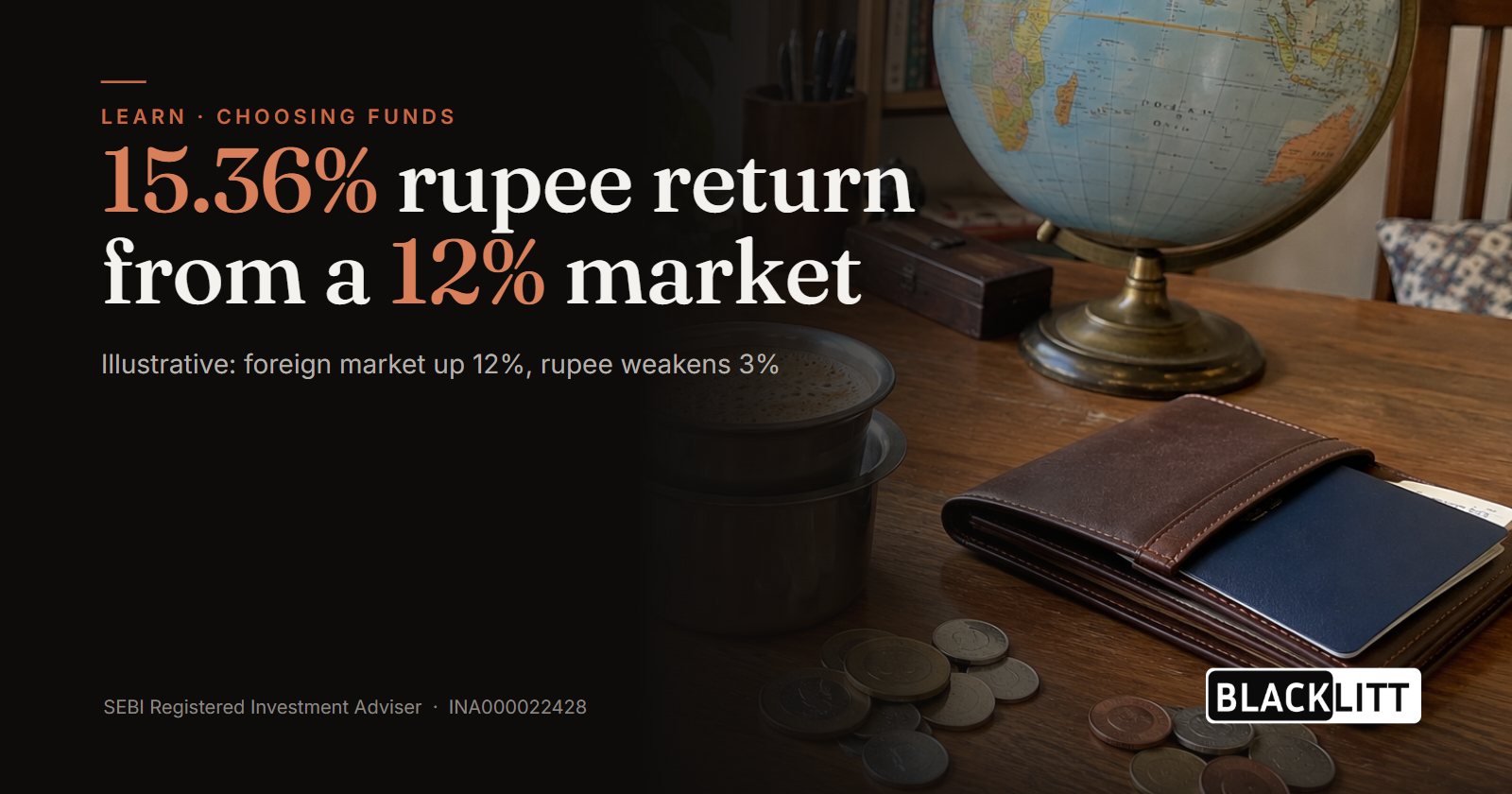
The rupee return combines the two moves. Suppose a foreign market rises 12% in a year and the rupee weakens 3% against the foreign currency. The rupee return is (1 + 12%) × (1 + 3%) − 1, which gives 15.36%. The same calculation gives the other figures below.
| Foreign market | Rupee move | Rupee return (%) |
|---|---|---|
| +12% | Rupee weakens 3% | 15.36 |
| +12% | Unchanged | 12.00 |
| +12% | Rupee strengthens 3% | 8.64 |
| -10% | Rupee weakens 3% | -7.30 |
| -10% | Rupee strengthens 3% | -12.70 |
Illustrative one-year figures. The foreign return and the rupee move are assumed, and costs and taxes are left out.
Illustrative one-year figures. Costs and taxes left out.
The last two rows show the other side. A falling foreign market still loses money when the rupee weakens, though the loss is smaller. A strengthening rupee makes the same fall hurt more.
International fund risk in practice
The risks stack. The foreign market can fall, the rupee can strengthen, and a single-country fund depends on one economy and one currency.
Diversification is the usual reason to hold one, since foreign markets do not always move with Indian shares. That benefit is a tendency, not a promise, and it can fade when most markets fall together.
Limits on overseas investing
SEBI and RBI cap how much the Indian fund industry as a whole can invest overseas. For this reason, some international funds have paused fresh inflows at times. A paused fund keeps its existing holdings and its NAV still moves, but you may not be able to add money or start a new SIP until it reopens.
Tax on international mutual fund gains
Tax depends on the holding period and the type of units, not on the fund's name. For units that are not listed, a gain made within 24 months is short-term and taxed at the investor's slab rate. After 24 months, the gain is long-term and taxed at 12.5% without indexation. These rules are as of October 2026.
Suppose ₹5 lakh grows to ₹7 lakh in an unlisted feeder fund. The gain is ₹2 lakh, and the tax depends on when the units are sold.
| Sale timing | Gain (₹ lakh) | Tax rate (%) | Tax (₹) |
|---|---|---|---|
| Within 24 months | 2.00 | 30.00 | 60,000 |
| After 24 months | 2.00 | 12.50 | 25,000 |
Illustrative figures with an assumed 30% slab rate. Surcharge and the 4% cess are left out. The ₹1.25 lakh exemption applies only to equity-oriented funds, so it does not reduce this gain.
For the general rules on how each category is taxed, see how mutual funds are taxed in India.
Choosing an international fund
Start with the structure, then the cost. A feeder fund's total cost is the sum of both expense ratios. Then work through these checks:
- Structure. Know whether the scheme holds foreign shares directly or through another fund.
- Cost. Add up every layer, using the expense ratio of each scheme.
- Inflow status. Confirm the scheme is taking fresh money before a SIP starts.
- Share of the portfolio. Decide how much of your money should sit abroad, given that both the foreign market and the rupee can move sharply.
- Horizon. Market and currency swings can last several years, so money needed within a short time is a poor fit.
The same two-layer cost question comes up with a gold fund of funds, which holds gold ETFs rather than gold itself.
Frequently asked questions
Do international funds carry more risk than Indian equity funds?
They carry different risks. Returns depend on the foreign market and on the rupee, so moves can be sharper in both directions. Some funds also hold a single country or sector, which adds concentration. A common approach is to hold them as one part of a portfolio rather than the whole of it.
Does a weaker rupee always help international fund returns?
No. A weaker rupee adds to the rupee return when the foreign market holds steady or rises, and a stronger rupee takes away from it. A falling foreign market can still lose money: in this article's illustration, a 10% fall with a 3% weaker rupee still gives -7.30%. Currency moves can also reverse in later years.
Can an international fund stop taking new investments?
Yes. Indian funds that invest abroad share an industry-wide overseas investment limit set by SEBI and RBI. When that limit is reached, schemes can pause fresh investments for a period, and some have done so. Check whether the scheme is accepting new money before you start a SIP, because the status can change.
Disclaimer
This article reflects the author's views as of 10 November 2026. Past performance does not indicate future returns. Examples that use assumed returns are for illustration only and are not projections. Consider your own goals and risk profile before investing.
Investment in securities market are subject to market risks. Read all the related documents carefully before investing.
The securities quoted are for illustration only and are not recommendatory.
Registration granted by SEBI, membership of BASL and certification from NISM in no way guarantee performance of the intermediary or provide any assurance of returns to investors.
Blacklitt Technologies Private Limited · SEBI RIA INA000022428 · BSE enlistment 2491