
What Is SIP (Systematic Investment Plan) and How It Works
A SIP, or systematic investment plan, is a way to invest a fixed amount in a mutual fund at regular intervals, usually every month, through an automatic bank debit. Each instalment buys units at that day's NAV.
The idea is simple. You pick a fund, set an amount and a date, and the same amount goes in every month until you change or stop it. The SIP meaning lies in the routine, not in a special product.
SIP meaning and monthly mechanics
A SIP runs on a mandate you set up once with your bank or investment platform. On each due date the bank debits the instalment, and the fund house allots units at that day's NAV. The NAV, or net asset value, is the price of one unit. If the NAV is ₹50 and ₹5,000 goes in, you receive 100 units. How NAV is set explains the price in more detail.
Rupee cost averaging in practice
Rupee cost averaging describes what happens when you buy a fixed rupee amount at changing prices. When the NAV falls, the same ₹5,000 buys more units. When it rises, it buys fewer. The table follows six hypothetical monthly instalments of ₹5,000.
| Month | NAV (₹) | Units bought |
|---|---|---|
| 1 | 50.00 | 100.00 |
| 2 | 45.00 | 111.11 |
| 3 | 40.00 | 125.00 |
| 4 | 44.00 | 113.64 |
| 5 | 48.00 | 104.17 |
| 6 | 52.00 | 96.15 |
| Total (₹30,000 invested) | — | 650.07 |
Illustrative: hypothetical NAVs, ₹5,000 on the same date each month. Units rounded to two decimals.
The six instalments bought 650.07 units for ₹30,000, an average cost of ₹46.15 per unit. The simple average of the six NAVs is ₹46.50. The average cost is lower because more units came in when the NAV was low.
Limits of rupee cost averaging
Averaging lowers the average price when prices swing, and it removes the need to guess the right month. It does not protect you from loss. If the NAV keeps falling after your first instalment, each new purchase lowers your average cost, but the holding can still be worth less than you paid.
In a market that rises steadily from the first month, a lump sum invested at the start usually ends ahead of a SIP, because the money is in the market for longer. Compare the two approaches with the same assumptions.
Growth of ₹5,000 a month over time
Time does most of the work. The table shows ₹5,000 invested at the start of every month at a constant assumed return of 12% a year. Real returns vary from year to year and can be negative for long stretches, so read these values as a shape rather than a forecast.
| Years | Invested (₹ lakh) | Value at assumed 12% a year (₹ lakh) |
|---|---|---|
| 5 | 3.00 | 4.06 |
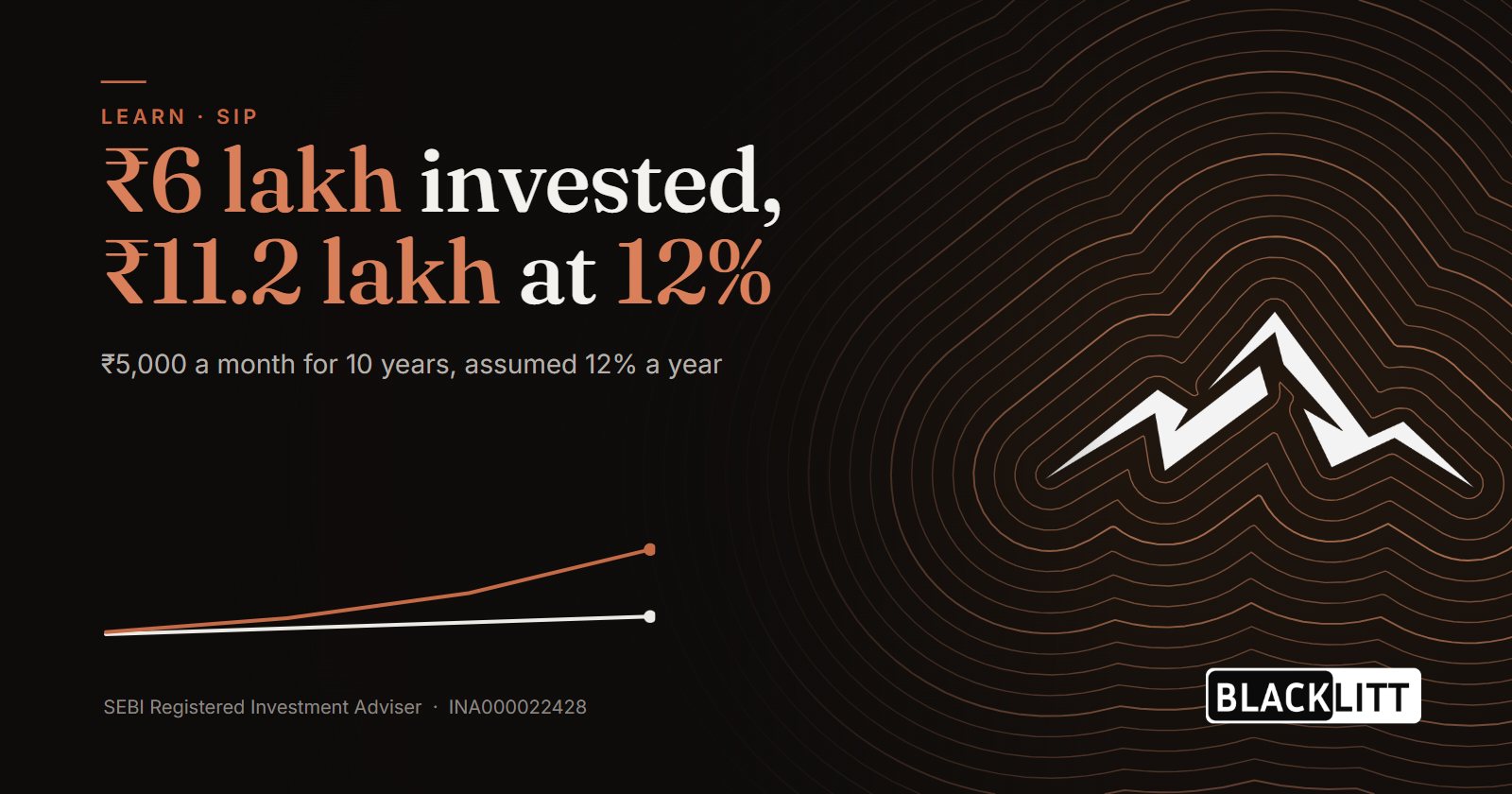
| 10 | 6.00 | 11.20 |
| 15 | 9.00 | 23.80 |
| 20 | 12.00 | 45.99 |
Illustrative: ₹5,000 at the start of each month at a constant assumed return.
- Invested
- Value at assumed 12%
Illustrative figures at an assumed 12% a year. Same figures as the table above.
Most of the growth arrives late. At an assumed 12% a year, ₹12 lakh invested over 20 years becomes ₹45.99 lakh, while ₹6 lakh invested over 10 years becomes ₹11.2 lakh. The 10% and 12% cases over ten years show how much the return assumption matters.
| ₹5,000 a month for 10 years | Assumed 10% a year | Assumed 12% a year |
|---|---|---|
| Amount invested (₹ lakh) | 6.00 | 6.00 |
| Value after 10 years (₹ lakh) | 10.07 | 11.20 |
Illustrative: constant assumed returns, the same monthly amount in both columns.
A constant return makes these figures look smoother than equity funds are. Equity fund values can fall sharply in a bad year and can stay below an earlier peak for a long time.
Practical points before you start
Choosing the date
Pick a date a few days after your salary usually arrives, so the debit has funds to clear.
Mandate and auto-debit
A SIP runs on an auto-debit mandate that you approve once, usually through your bank or the platform. A failed debit can interrupt the plan, so keep a buffer in the linked account.
Pausing, stopping and step-ups
You can pause or stop a SIP at any time. Stopping future instalments does not sell the units you already hold, so it creates no tax event by itself. Redeeming units is a separate decision, and exit loads may apply. A step-up raises the instalment each year as income grows; how a step-up works shows the effect.
Tax on SIP units in 2026
Each instalment is a separate purchase, so each unit has its own holding period, counted from its purchase date. As of October 2026, for equity-oriented funds with at least 65% in domestic listed equity, units sold within 12 months are short-term and taxed at 20%. Units held longer are long-term and taxed at 12.5% on gains above ₹1.25 lakh a financial year. These rates apply to units sold on or after 23 July 2024, plus surcharge and 4% cess.
Units of funds investing more than 65% in debt, bought on or after 1 April 2023, are taxed at slab rates regardless of holding period.
Frequently asked questions
Is a SIP the same as a mutual fund?
No. A SIP is a way of investing in a mutual fund, not a separate product. You choose the fund, the amount and the date, and each instalment buys units of that fund. Stopping the SIP does not sell the units you already hold.
Can you lose money in a SIP?
Yes. A SIP buys units of market-linked funds, so the value can fall, sometimes for years. Averaging lowers the average price you pay when prices swing, but it does not prevent losses in a falling market. The figures in this article are assumed, not forecasts.
How much should a beginner start with?
Start with an amount you can keep paying through a bad year, even if it is modest. Regular instalments matter more than the first amount, because a missed month breaks the pattern. You can raise the amount later, for example with a step-up.
Disclaimer
This article reflects the author's views as of 28 October 2026. Past performance does not indicate future returns. Examples that use assumed returns are for illustration only and are not projections. Consider your own goals and risk profile before investing.
Investment in securities market are subject to market risks. Read all the related documents carefully before investing.
The securities quoted are for illustration only and are not recommendatory.
Registration granted by SEBI, membership of BASL and certification from NISM in no way guarantee performance of the intermediary or provide any assurance of returns to investors.
Blacklitt Technologies Private Limited · SEBI RIA INA000022428 · BSE enlistment 2491