What Is a Flexi Cap Fund and How It Differs From Multi Cap
- Choosing funds
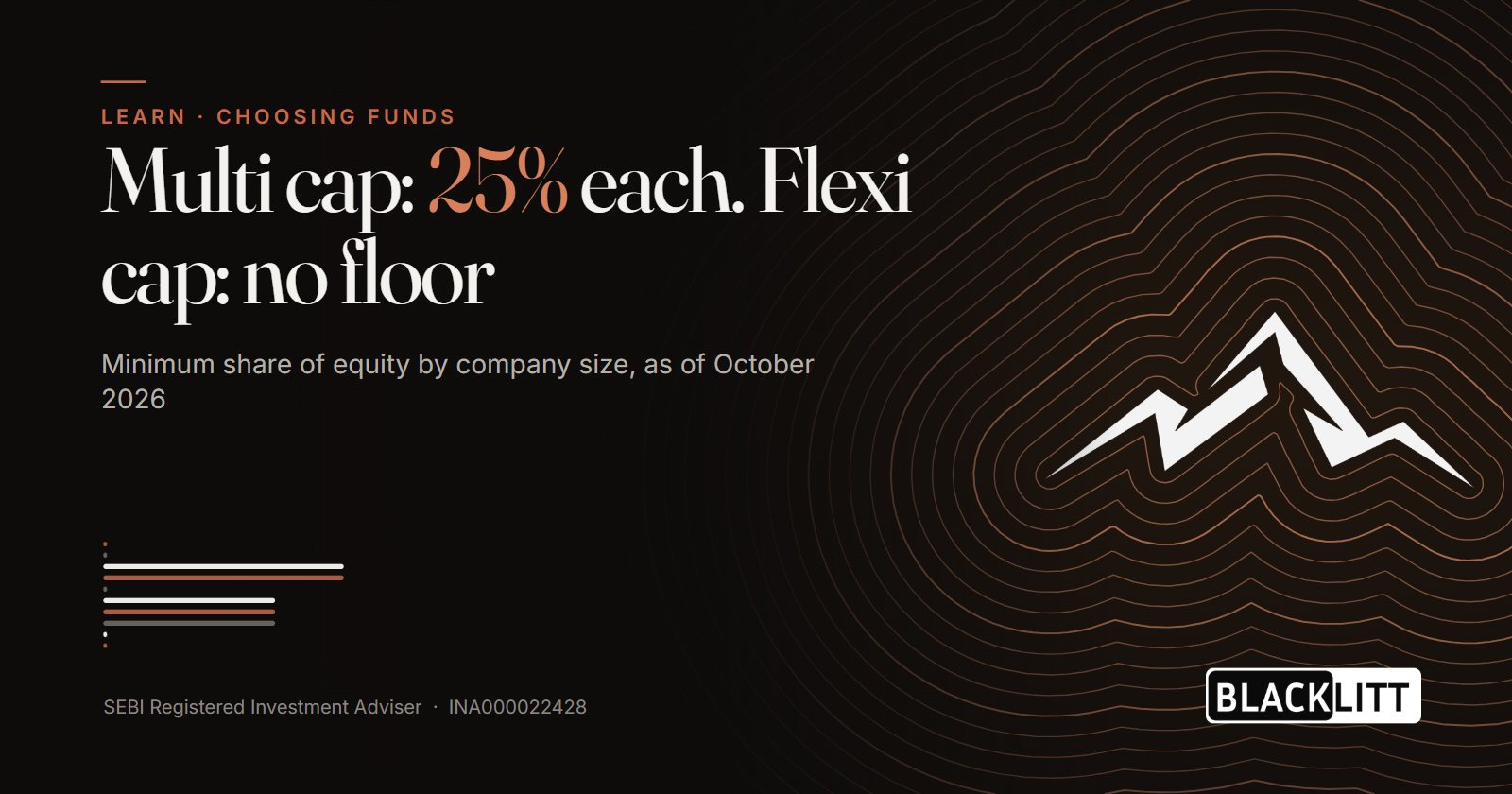
A flexi cap fund is an equity mutual fund that must keep at least 65% in equities but has no minimum for any company size, so its manager chooses how much goes to large, mid and small companies. A multi cap fund must hold at least 75% in equities and at least 25% each in large, mid and small companies.
That one difference shapes how the two categories behave. New to the topic? Start with what a mutual fund is.
Flexi cap fund meaning and size rules
Equity funds are grouped by the size of the companies they hold. Large caps are companies ranked 1 to 100 by full market capitalisation. Mid caps are ranked 101 to 250, and small caps are ranked 251 onwards. AMFI publishes the list every six months.
SEBI's circular of 26 February 2026 did not change these definitions, so the rules below still apply as of October 2026. The circular is covered in SEBI's 2026 recategorisation.
The table shows the minimum each category must hold.
| Category | Equity minimum (%) | Large cap minimum (%) | Mid cap minimum (%) | Small cap minimum (%) |
|---|---|---|---|---|
| Large Cap | 80 | 80 | 0 | 0 |
| Large & Mid Cap | 70 | 35 | 35 | 0 |
| Multi Cap | 75 | 25 | 25 | 25 |
| Flexi Cap | 65 | 0 | 0 | 0 |
Minimums under SEBI categorisation rules, as of October 2026. A fund may hold more than these minimums. 0 means no minimum applies.
- Large cap min
- Mid cap min
- Small cap min
Minimums under SEBI categorisation rules, as of October 2026. 0 means no minimum.
Flexi cap has a 65% equity floor and no size floors, so its manager sets the size mix entirely. Multi cap is the only one of the four categories that sets a floor in all three size classes.
Flexi cap vs multi cap at a glance
The table compares the two categories measure by measure.
| Measure | Multi Cap | Flexi Cap | Gap (points) |
|---|---|---|---|
| Equity minimum (%) | 75 | 65 | 10 |
| Large cap minimum (%) | 25 | 0 | 25 |
| Mid cap minimum (%) | 25 | 0 | 25 |
| Small cap minimum (%) | 25 | 0 | 25 |
| Who sets the size mix | Rules set the floors, the manager chooses the rest | The manager alone | — |
| Tax treatment | Equity-oriented | Equity-oriented | — |
Gap is Multi Cap minus Flexi Cap. Minimums under SEBI categorisation rules, as of October 2026.
The 25% floor in each size class is what gives multi cap a steadier share of small companies. A flexi cap fund has no such floor, so its small-company share can be whatever the manager decides.
Multi cap behaviour in practice
Because the category must hold at least 25% of its equity in small companies, part of its return each year depends on smaller businesses. Small companies can grow quickly, but they also tend to fall further in a market downturn. Since the floor keeps that exposure in place, a multi cap fund can see sharper falls than a fund holding fewer small companies.
The trade-off is predictability of mix. The floor in each size class is set by the category, so you know the minimum even when the manager's views change.
Flexi cap behaviour in practice
A flexi cap fund's mix moves with the manager's calls. The manager may lean towards large companies in a weak market and add mid and small companies when prices look attractive, or do the reverse. If those calls are right, the fund can soften a downturn. If they are wrong, it can hold more small-company risk just before a fall, or miss a recovery. The outcome depends on the manager's decisions rather than on a fixed rule.
Investors each category may suit
Each category suits different readers, and neither is better for everyone.
A multi cap may suit readers who:
- want a rule-based share of smaller companies in their equity money;
- have a long horizon and can accept sharper falls in small-company stocks.
A flexi cap fund may suit readers who:
- want the manager to adjust the company-size mix as conditions change;
- are comfortable judging a manager's record and checking the mix from time to time.
Both need a long horizon, since equity prices swing widely over short periods.
Tax treatment is the same for both
Both categories are equity-oriented funds, because each holds at least 65% in domestic listed equity. As of October 2026, for units sold on or after 23 July 2024, gains on units held for more than 12 months are taxed at 12.5% above ₹1.25 lakh in a financial year, provided securities transaction tax was paid on the units. Gains on units held for 12 months or less are taxed at 20%. Surcharge and 4% cess apply on top. The taxation guide explains holding periods in more detail.
Checking a fund's current mix
A category label shows the rules a fund must follow, not the mix it holds today. To see the actual mix, open the fund's monthly portfolio factsheet on the fund house's website. Look for the market-cap split, or sort the holdings by company size yourself. A multi cap fund should show at least 25% in each class. A flexi cap fund's split shows only the manager's choice, so check it every few months, because it can change quickly.
Frequently asked questions
Is a flexi cap fund the same as a multi cap fund?
No. Both invest across company sizes, but a multi cap fund must hold at least 25% each in large, mid and small companies, while a flexi cap fund has no size minimums. Both are equity funds, and both are taxed the same way.
Which category is more volatile, flexi cap or multi cap?
No category has a fixed level of swings, because the actual mix changes over time. A multi cap keeps at least 25% of its equity in small companies, which often means sharper falls in a downturn. A flexi cap fund's small-company share can be higher or lower, depending on the manager.
Should I choose a flexi cap fund or a multi cap fund?
Neither is right for everyone. Consider whether you want a fixed share of smaller companies or want the manager to adjust the mix. Then check the fund's monthly factsheet, compare costs on the Direct plan of each fund, and make sure your time horizon suits equity risk.
Disclaimer
This article reflects the author's views as of 23 October 2026. Past performance does not indicate future returns. Examples that use assumed returns are for illustration only and are not projections. Consider your own goals and risk profile before investing.
Investment in securities market are subject to market risks. Read all the related documents carefully before investing.
The securities quoted are for illustration only and are not recommendatory.
Registration granted by SEBI, membership of BASL and certification from NISM in no way guarantee performance of the intermediary or provide any assurance of returns to investors.
Blacklitt Technologies Private Limited · SEBI RIA INA000022428 · BSE enlistment 2491