Direct vs Regular Mutual Fund Plans: What Is the Difference?
- Choosing funds
A direct plan is a version of a mutual fund bought without a distributor, so it has a lower expense ratio. A regular plan of the same fund is bought through a distributor, who is paid from the fund's expenses. The portfolio and fund manager are identical, so the direct vs regular mutual fund difference is cost.
New to funds? Start with what a mutual fund is.
Direct plan meaning and origin
The direct plan meaning is simple: it is the same scheme, sold with no distribution cost. SEBI's circular of 13 September 2012 required fund houses to offer a separate direct option for every scheme, effective 1 January 2013, for both existing and new schemes. The regular plan meaning is the reverse: a plan sold through a distributor, with that distribution cost built into its expenses.
Direct vs regular mutual fund costs
The table shows the practical differences.
| Attribute | Direct plan | Regular plan |
|---|---|---|
| Where it is bought | From the fund house or a platform, without a distributor | Through a distributor or adviser |
| Distribution cost | None | Paid to the distributor from the fund's expenses |
| Expense ratio | Lower | Higher |
| NAV (net asset value, the price of one unit) | Rises faster over time | Rises more slowly over time |
| Portfolio and fund manager | Same as the regular plan | Same as the direct plan |
| Suits | Investors who research and place orders themselves | Investors who want a distributor's ongoing help |
The expense ratio is the yearly fee a fund deducts to run the scheme. In a regular plan, part of that fee pays the distributor. A direct plan has no such payment, so its expense ratio is lower and the saving stays in the fund, lifting its NAV. Because both plans hold the same stocks and bonds, cost is the main reason their returns differ.
Expense ratio ceilings from April 2026
As of October 2026, the SEBI (Mutual Funds) Regulations, 2026 set ceilings on the base expense ratio (BER) of open-ended schemes, effective 1 April 2026. The ceilings below are maximums. They are not the fee of any particular fund.
| Daily net assets slab | Equity-oriented BER ceiling (%) | Other than equity BER ceiling (%) |
|---|---|---|
| First ₹500 crore | 2.10 | 1.85 |
| Assets above the full slab schedule | 0.95 | 0.70 |
Shortened from the full slab schedule.
Growth gap on a ₹10 lakh lump sum
Suppose you invest ₹10 lakh once at an assumed 12% a year gross return, less an expense ratio of 0.7% in the Direct plan and 1.7% in the Regular plan.
- Direct
- Regular
Illustrative figures at an assumed 12% a year gross return, less each plan's expense ratio. Labels are years.
| Year | Direct (₹ lakh) | Regular (₹ lakh) | Gap (₹ lakh) |
|---|---|---|---|
| 0 | 10.00 | 10.00 | 0.00 |
| 5 | 17.08 | 16.33 | 0.75 |
| 10 | 29.17 | 26.65 | 2.52 |
| 15 | 49.82 | 43.51 | 6.31 |
| 20 | 85.09 | 71.04 | 14.05 |
| 25 | 145.34 | 115.98 | 29.36 |
Illustrative figures at an assumed 12% a year gross return, less each plan's expense ratio.
By year 25, the Direct plan is worth ₹145.34 lakh against ₹115.98 lakh for the Regular plan, a difference of ₹29.36 lakh on a ₹10 lakh investment. The 1 percentage point a year gap is an assumption, and actual gaps vary by fund.
Gap on a monthly SIP over 20 years
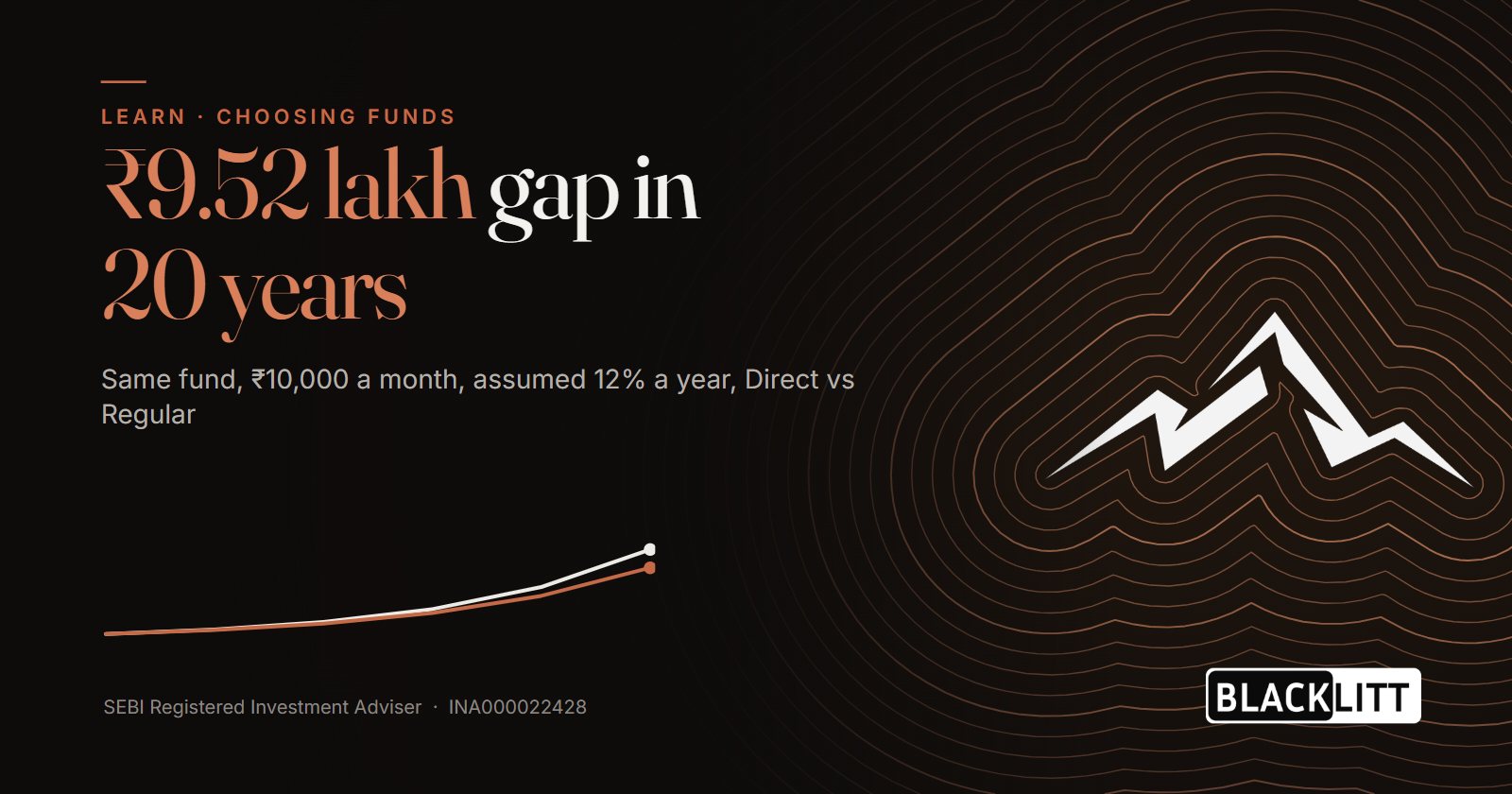
Now suppose you invest ₹10,000 every month for 20 years, which is ₹24 lakh in total, under the same assumed return and expense ratios.
| ₹10,000 a month for 20 years | Direct plan | Regular plan | Difference |
|---|---|---|---|
| Amount invested (₹ lakh) | 24.00 | 24.00 | — |
| Value after 20 years (₹ lakh) | 84.55 | 75.02 | 9.52 |
Illustrative SIP figures at the same assumptions as the lump sum example.
The same monthly amount ends ₹9.52 lakh higher in the Direct plan. For ways to raise the monthly amount over time, see how a SIP step-up works.
Reasons some investors still choose regular plans
A regular plan can make sense for an investor who wants a distributor's help. The distributor's commission pays for service: help choosing funds, handling paperwork, reviewing a portfolio and staying invested during falls. For someone who might otherwise sell in a downturn, that support can be worth more than the cost gap.
Telling the two plans apart
Check the scheme name. A direct plan carries the word "Direct" in its name, such as "Scheme name - Direct Plan - Growth". Regular plans do not. Your account statement or the fund house's website shows the plan name, and each plan has its own ISIN code.
Switching from a regular plan to a direct plan
Switching counts as a redemption of your regular units and a fresh purchase of direct units, so it is a taxable event. Two costs can apply. Capital gains tax is due on any gain on the units you sell. For equity-oriented funds, gains on units held over 12 months are taxed at 12.5% above ₹1.25 lakh a financial year, and gains on units held 12 months or less at 20%, plus surcharge and cess, for units sold on or after 23 July 2024. An exit load applies if the units are redeemed within the fund's exit-load period. Check both before you switch.
For the full set of rules, see how mutual funds are taxed in India.
Choosing between direct and regular
Start with how you invest. If you research funds and place orders yourself, a direct plan keeps costs lower. If you want a distributor's guidance and accept the higher cost, a regular plan may suit you. Whichever you pick, compare the expense ratio of the specific plan you are considering.
Frequently asked questions
Is a direct plan better than a regular plan?
A direct plan is cheaper because it has no distributor commission, so it usually gives a higher return from the same portfolio. A regular plan can still suit an investor who values a distributor's guidance and is willing to pay for it. The choice depends on whether that service is worth the cost gap to you.
Can I switch from a regular plan to a direct plan?
Yes, but the switch counts as a redemption of your regular units and a fresh purchase of direct units. Capital gains tax may apply to the gain, and an exit load may apply if you are still within the fund's exit-load period. Check both costs before you switch.
How can I tell if I hold a direct plan?
Look for the word Direct in the scheme name on your account statement or the fund house's website, such as 'Direct Plan - Growth'. Regular plans do not carry that word. Each plan also has its own ISIN code, which you can check on the statement.
Does a direct plan always give higher returns?
It gives a higher return on the same portfolio, because its expense ratio is lower and the saving stays in the fund. The gap depends on each fund's costs and on how long you hold it. The illustrations here assume a gap of 1 percentage point a year, and actual gaps vary by fund.
Disclaimer
This article reflects the author's views as of 23 October 2026. Past performance does not indicate future returns. Examples that use assumed returns are for illustration only and are not projections. Consider your own goals and risk profile before investing.
Investment in securities market are subject to market risks. Read all the related documents carefully before investing.
The securities quoted are for illustration only and are not recommendatory.
Registration granted by SEBI, membership of BASL and certification from NISM in no way guarantee performance of the intermediary or provide any assurance of returns to investors.
Blacklitt Technologies Private Limited · SEBI RIA INA000022428 · BSE enlistment 2491