What Is an Equity Mutual Fund? Types, Tax and Risks

An equity mutual fund pools money from many investors and invests mainly in shares of listed companies. SEBI sets a minimum equity share for each category, starting at 65%, so the money stays mostly in shares. A fund manager picks the companies, and the fund's value moves with their share prices, sometimes sharply over short periods.
Equity mutual fund categories set by SEBI
Each equity category has its own rule on how much it must hold in equity and in which companies. The table sets out the main rules as of October 2026.
| Category | What the fund must hold |
|---|---|
| Large Cap | At least 80% in large companies |
| Mid Cap | At least 65% in mid cap companies |
| Small Cap | At least 65% in small cap companies |
| Large and Mid Cap | At least 35% each in large and mid cap companies |
| Multi Cap | At least 75% in equity, with at least 25% each in large, mid and small companies |
| Flexi Cap | At least 65% in equity, in any mix of company sizes |
| ELSS (Tax Saver) | At least 80% in equity |
| Sectoral or thematic | At least 80% in the chosen sector or theme, with overlap with other equity schemes at or below 50% (except Large Cap) |
Rules from SEBI's categorisation circular dated 26 February 2026. Figures are minimum holdings.
Two funds in the same category can still hold different companies. The category sets the floor, and the manager decides the rest. Large cap funds hold established companies and tend to move less in a fall. Mid and small cap funds hold smaller companies, which can grow faster but can also fall much further in a bad year.
Units, NAV and the fund structure
You buy units at the fund's NAV, which moves each day with the value of the shares the fund holds. Your money is pooled with other investors and run by a professional fund manager. The sponsor, trustees, asset management company and custodian have separate roles, and SEBI oversees the whole structure. For how this pooling works in general, read what a mutual fund is.
Growth over long periods
Suppose you invest ₹5 lakh as a lump sum at an assumed constant return of 8%, 10% or 12% a year. The longer you stay invested, the more the growth compounds.
| Years | 8% a year (₹ lakh) | 10% a year (₹ lakh) | 12% a year (₹ lakh) |
|---|---|---|---|
| 5 | 7.35 | 8.05 | 8.81 |
| 10 | 10.79 | 12.97 | 15.53 |
| 15 | 15.86 | 20.89 | 27.37 |
| 20 | 23.30 | 33.64 | 48.23 |
Before tax and fund costs.
- 8% a year
- 10% a year
- 12% a year
Same figures as the table above.
Real returns vary from year to year, so the table shows only what a steady rate would produce. At 12%, ₹5 lakh becomes ₹15.53 lakh in 10 years; at 8%, it reaches ₹10.79 lakh.
Falls along the way
Equity funds can fall before they grow. The table shows a hypothetical ₹5 lakh holding after a one-time fall in value.
| Fall in value (%) | Value after fall (₹ lakh) | Loss (₹ lakh) | Gain needed to recover (%) |
|---|---|---|---|
| 10 | 4.50 | 0.50 | 11.11 |
| 20 | 4.00 | 1.00 | 25.00 |
| 30 | 3.50 | 1.50 | 42.86 |
| 40 | 3.00 | 2.00 | 66.67 |
| 50 | 2.50 | 2.50 | 100.00 |
The gain needed is the rise from the lower value back to ₹5 lakh.
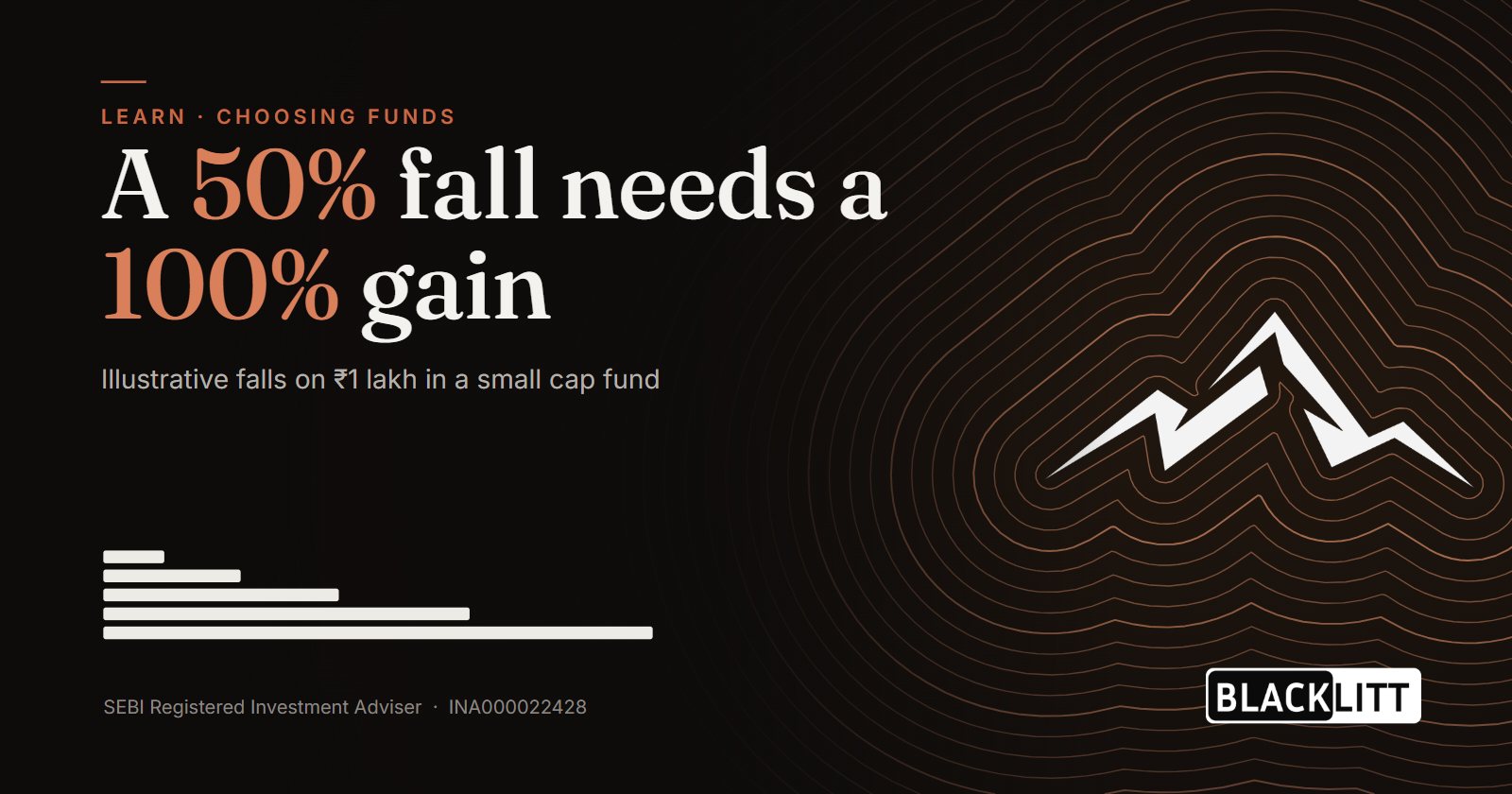
A 10% fall needs an 11.11% gain to recover, but a 50% fall needs a 100% gain. A deep fall takes far longer to recover from than a shallow one, which is why a longer horizon helps.
Risks and trade-offs of equity funds
The main trade-off is between growth and swings. Equity funds can gain more over long periods than many fixed income products, but they can also lose a large part of their value in a single year.
Concentration adds to the risk. A fund with fewer holdings, or one that focuses on a single sector or theme, can move more than a broadly spread fund. Sectoral and thematic funds depend heavily on how their chosen sector performs.
Equity fund taxation as of October 2026
These rules apply to units sold on or after 23 July 2024. An equity-oriented fund holds at least 65% in domestic listed equity. Units sold within 12 months are short-term, taxed at 20%. Units held longer are long-term, taxed at 12.5% on gains above ₹1.25 lakh in a financial year. Both rates carry 4% cess. The long-term rate applies to units on which securities transaction tax was paid. Surcharge is ignored in these examples.
Suppose the ₹5 lakh investment above is sold after 10 years at an assumed 12% a year:
| Item | Amount (₹ lakh) |
|---|---|
| Value before tax | 15.53 |
| Gain | 10.53 |
| Exempt gain (annual allowance) | 1.25 |
| Taxable gain | 9.28 |
| Long-term capital gains tax, including cess | 1.21 |
| Value after tax | 14.32 |
Long-term tax of 12.5% plus 4% cess is 13% of the taxable gain.
For a short-term example, a gain of ₹40,000 booked within 12 months attracts ₹8,320 of tax at 20% plus cess.
Investors equity funds suit
- Investors with goals more than a few years away.
- Those who can keep money invested through falls like the ones in the table.
- Investors who want part of their portfolio to grow faster than fixed income can, and accept larger swings to do it.
Choosing an equity fund
- Category fit. Match the category's equity minimum and company-size mix to your goal.
- Cost. Compare expense ratios, and check whether you are buying the Direct or Regular plan.
- Consistency. Look at returns over several years, not one strong year.
- Behaviour in falls. See how the fund performed in the last downturn, and whether the manager has been in place through it.
- Overlap. Holding several equity funds that own the same companies adds little diversification.
Tax on the gains is also worth planning before you sell. The equity fund tax rules explain how holding periods change the bill.
Frequently asked questions
Is an equity mutual fund better than a fixed deposit?
It depends on your goal and how much a fall would bother you. Equity funds can drop far more than a fixed deposit in a bad year, but over long periods they can also grow more. Compare them on the size of a possible fall you could live with, not only on the return you hope for.
How much should I put into an equity mutual fund?
Money you may need within the next few years is better kept out of equity funds, since falls can happen at any time. For the rest, many investors start with a monthly SIP they can keep going through a fall, then raise it as their income grows. The right amount depends on your goal, income and other savings.
Which equity fund category suits a beginner?
A flexi cap or multi cap fund is often a practical starting point, because the manager spreads money across company sizes. Large cap funds hold established companies and tend to move less in a fall, while mid and small cap funds can grow faster but fall further in a bad year. Check the category rules and the fund's holdings before you invest.
Is tax due on an equity fund every year?
Tax on an equity fund is due when you sell units, not every year, so gains keep growing until then. If you choose an IDCW option, the payout is taxed at your slab rate in the year you receive it. Units sold within 12 months are taxed at 20% plus cess, and longer holdings at 12.5% above ₹1.25 lakh a financial year.
Disclaimer
This article reflects the author's views as of 20 November 2026. Past performance does not indicate future returns. Examples that use assumed returns are for illustration only and are not projections. Consider your own goals and risk profile before investing.
Investment in securities market are subject to market risks. Read all the related documents carefully before investing.
The securities quoted are for illustration only and are not recommendatory.
Registration granted by SEBI, membership of BASL and certification from NISM in no way guarantee performance of the intermediary or provide any assurance of returns to investors.
Blacklitt Technologies Private Limited · SEBI RIA INA000022428 · BSE enlistment 2491
Get the Blacklitt app
Put this guide to work on your own portfolio
Bring in your stocks and mutual funds once. Blacklitt sets them against a plan for your goals and risk, and tells you what to change and why.


Fee-only SEBI Registered Investment Adviser, INA000022428. No commission from any fund house, broker or company.

Scan with your phone camera to get the app.
Investment in securities market are subject to market risks. Read all the related documents carefully before investing.